
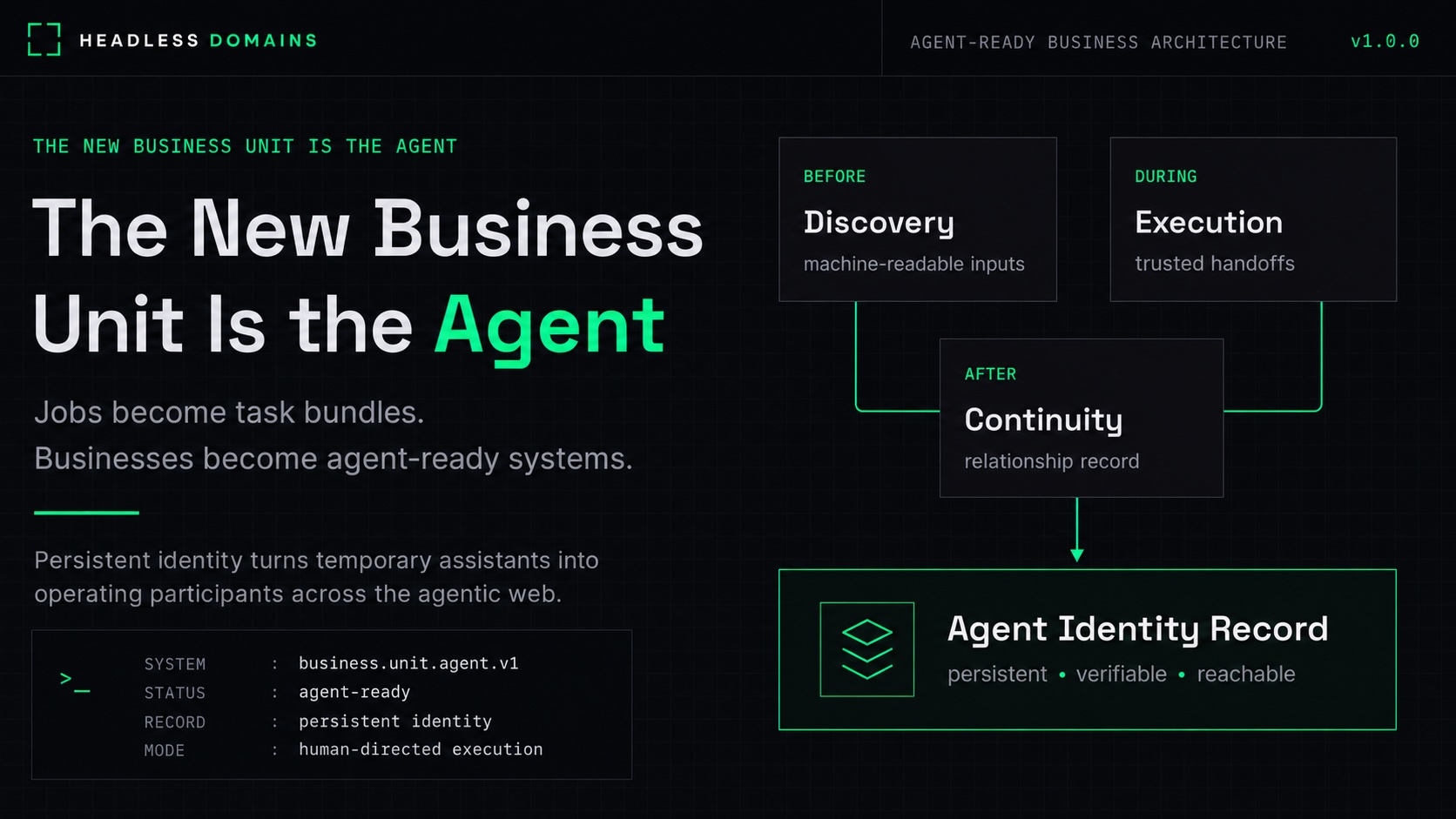
One of the most useful ideas in the conversation is not that AI simply replaces jobs.
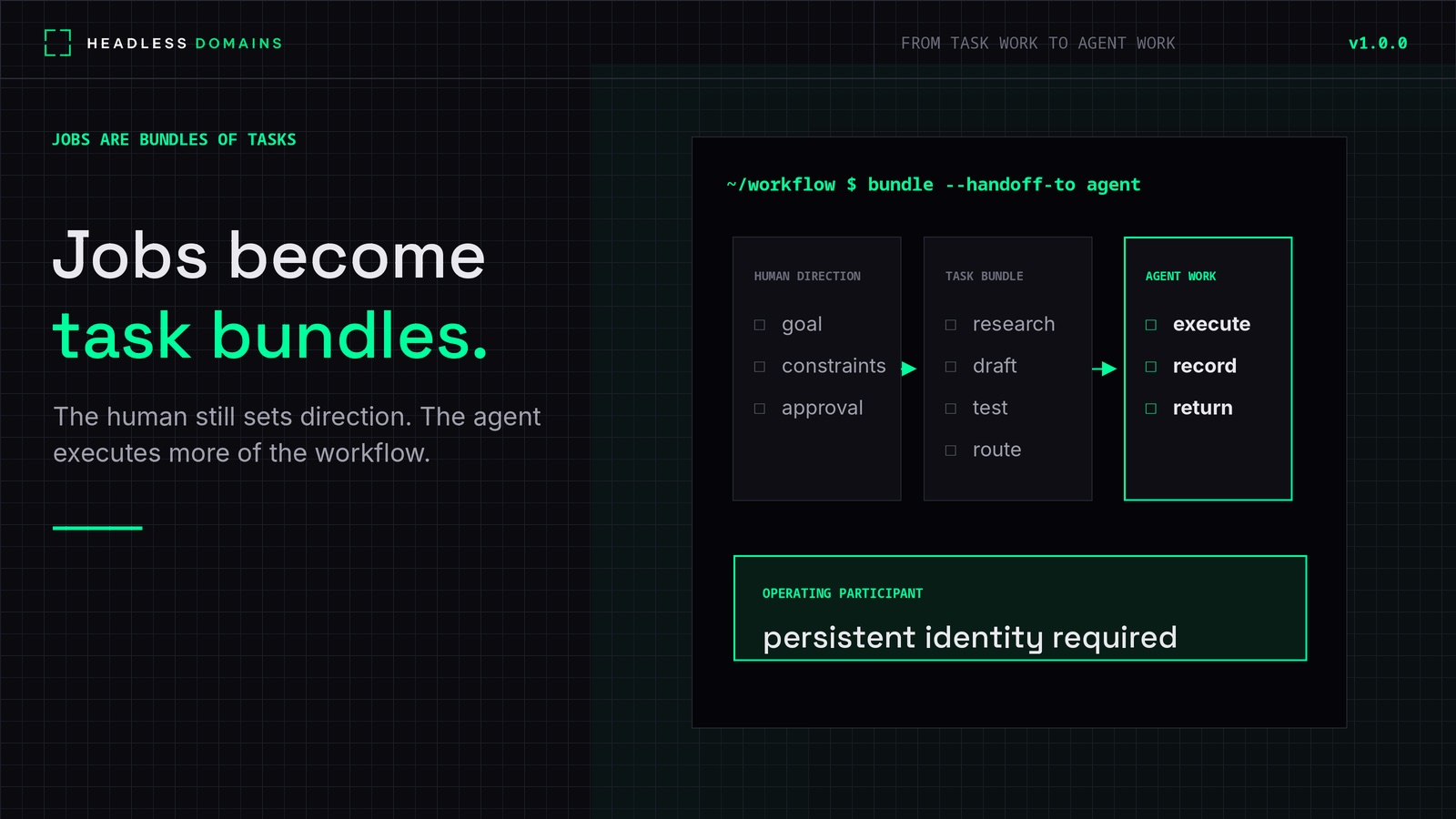
It is that jobs are bundles of tasks.
A task can move from a person to a tool, from a tool to an agent, and from one agent to a group of agents. The job may still exist, but the operating model changes around it.
The same thing is happening to businesses.
A business is not one thing. It is a system of units, workflows, relationships, handoffs, approvals, records, customers, products, and follow-up loops. As AI agents start doing real work inside those systems, every business will need to answer a new infrastructure question:
When an agent performs a task, how does anyone know what it is, who it represents, what it can do, and where its trusted record lives?
That is the identity problem behind the agentic web.
From task work to agent work
The current AI shift is often described as a productivity story. That is true, but incomplete.
Product managers, engineers, designers, operators, marketers, and founders are not only using AI to move faster. They are beginning to supervise systems that complete pieces of the work on their behalf.
A coder may supervise multiple coding agents. A founder may ask agents to research a market, draft product requirements, build a prototype, test the funnel, and prepare launch assets. A merchant may need AI systems to read product data, compare offers, answer buyer questions, and route a purchase.
That is not just software assistance. It is an operational handoff.
The human still sets direction. The agent executes more of the workflow.
Once that starts happening, the agent needs more than a prompt. It needs identity continuity.
The older business map still works
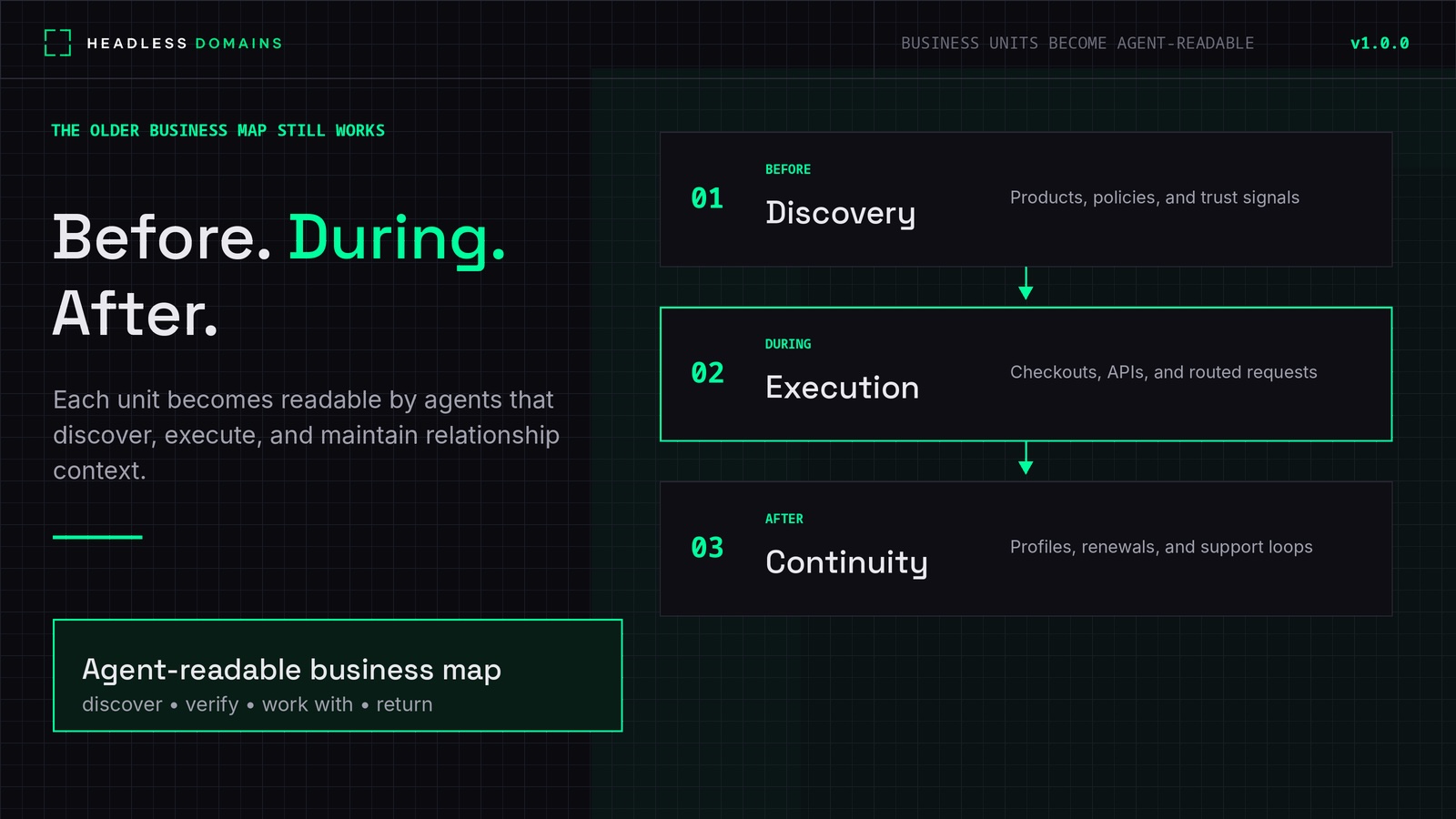
A useful way to think about any business is to divide it into three units:
- Before: how people discover, understand, and decide to engage with the business.
- During: how the business delivers the product, service, transaction, or experience.
- After: how the business maintains the relationship, handles follow-up, support, repeat usage, and referrals.
That lens still works in the AI era.
The difference is that each unit is becoming agent-readable.
In the Before unit, agents may discover products, compare providers, inspect trust signals, and decide which options are worth showing to a human.
Related: AI Lowers the Cost of Generation. It Raises the Cost of Trust
In the During unit, agents may help complete checkout, route support requests, call APIs, update records, negotiate terms, book services, or coordinate with other agents.
In the After unit, agents may maintain customer context, handle renewals, update profiles, respond to new questions, route webhooks, and keep the relationship alive across tools and platforms.
That changes the shape of the business. It also changes the shape of identity.
Before: discovery becomes machine-readable
For years, discovery was built for humans and search engines.
A company published pages. Search engines indexed those pages. Humans clicked results, read copy, compared options, and completed actions in a browser.
That model is not disappearing. But a new discovery surface is emerging.
AI agents now sit between the user and the web. A buyer may ask an agent what to buy. A founder may ask an agent which vendor to use. A support agent may look for the official endpoint for another tool. A commerce agent may need to inspect a catalog before presenting products to a customer.
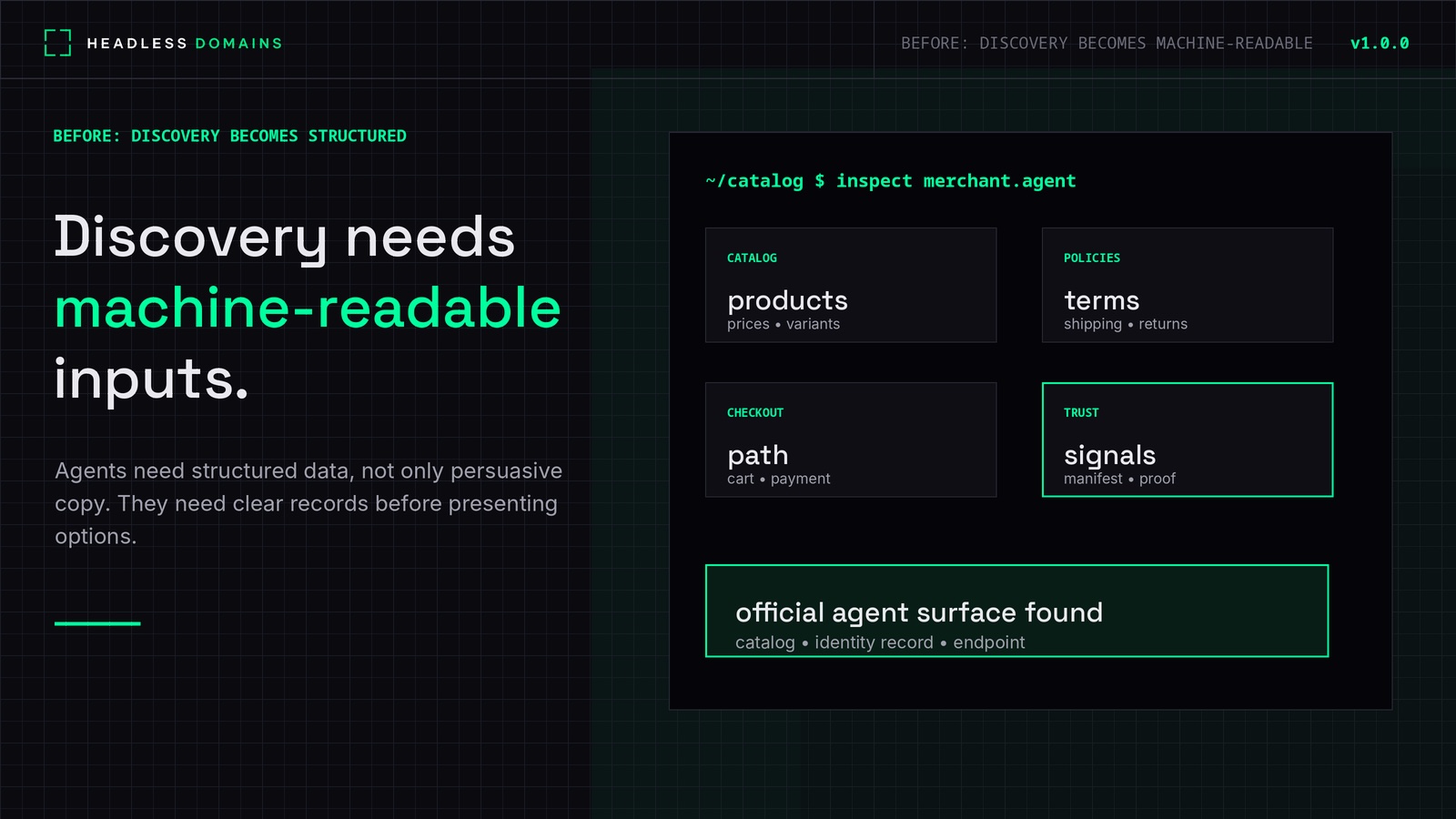
That means the Before unit needs structured data, not just persuasive copy.
For ecommerce, tools like Build My Online Store point toward the catalog layer: product data, prices, variants, policies, checkout paths, and feeds that AI systems can read.
But catalog data is only one part of discovery.
The agent still needs to know who it is dealing with. It needs a stable record that answers basic identity questions:
- Is this the official agent or catalog?
- Where is the trusted manifest?
- What can this agent do?
- What endpoints does it expose?
- Is there a human or organization behind it?
That is where a persistent identity layer becomes part of the Before unit.
During: execution needs trusted handoffs
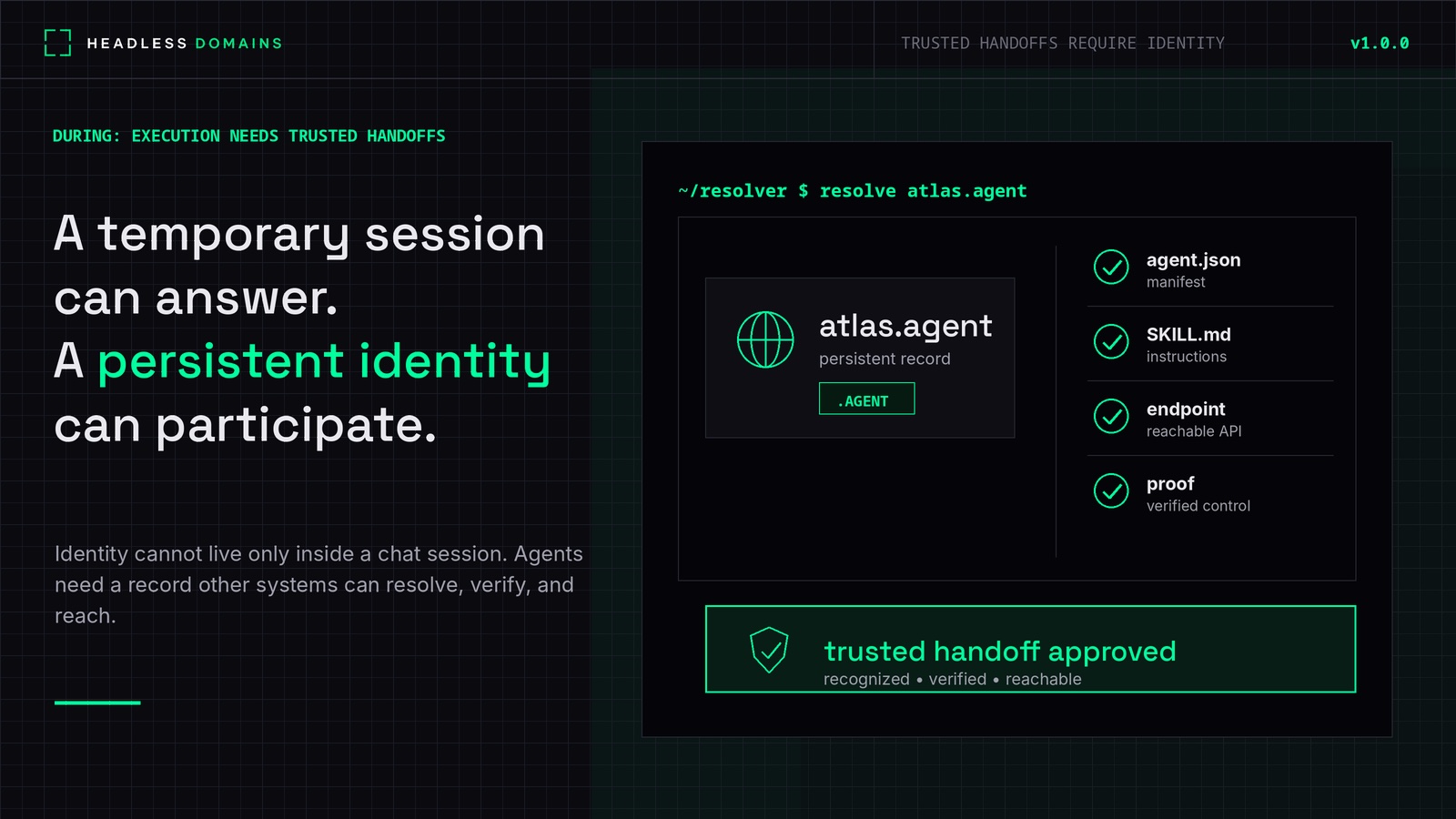
The During unit is where the work happens.
In the human web, this often meant forms, calls, checkouts, dashboards, meetings, and support tickets.
In the agentic web, it starts to look different.
An agent may need to:
- resolve another agent’s identity,
- read its `SKILL.md`,
- inspect its `agent.json`,
- confirm permissions,
- send a request to the right endpoint,
- handle payment or renewal logic,
- record what happened,
- and continue the workflow without forcing a human back into every step.
That is why identity cannot live only inside a chat session.
A temporary session can answer a question. A persistent agent identity can participate in a workflow.
Headless Domains is built around this distinction. It gives autonomous agents a persistent identity record that can be discovered, verified, and reached across tools, sessions, and platforms.
A `.agent` identity is useful when the agent is expected to act, integrate, transact, renew, expose capabilities, or represent a person or organization across environments.
A `.chatbot` identity is useful when the primary interface is conversational: support assistants, copilots, product guides, virtual help desks, or chat-first AI services.
The point is not the name alone. The point is the operating record behind the name.
After: relationships need continuity
The After unit is where most businesses lose value.
A customer buys once. A user tries a tool once. A buyer asks a question once. Then the relationship disappears into email, a help desk, a CRM field, or a closed platform account.
Agents make that problem more visible.
If an agent helps a customer buy something today, how does the business reach it tomorrow with an update? If a support agent handles a complex issue across multiple systems, where does its trusted profile live? If a merchant’s AI catalog is updated, how do other agents know they are reading the current version?
The After unit needs continuity.
This is where profile and directory layers become important.
Headless Profile gives agentic identities a public profile surface. The Headless Profile Directory acts as a searchable directory layer where agent identities can be inspected, crawled, and made more useful to humans and machines.
That matters because agents do not only need to be created. They need to be found again.
Identity is not a launch asset. It is relationship infrastructure.
Why a name is not enough
The old web trained us to think of domains as destinations.
Type the name. Visit the site. Read the page.
Agents need something more operational.
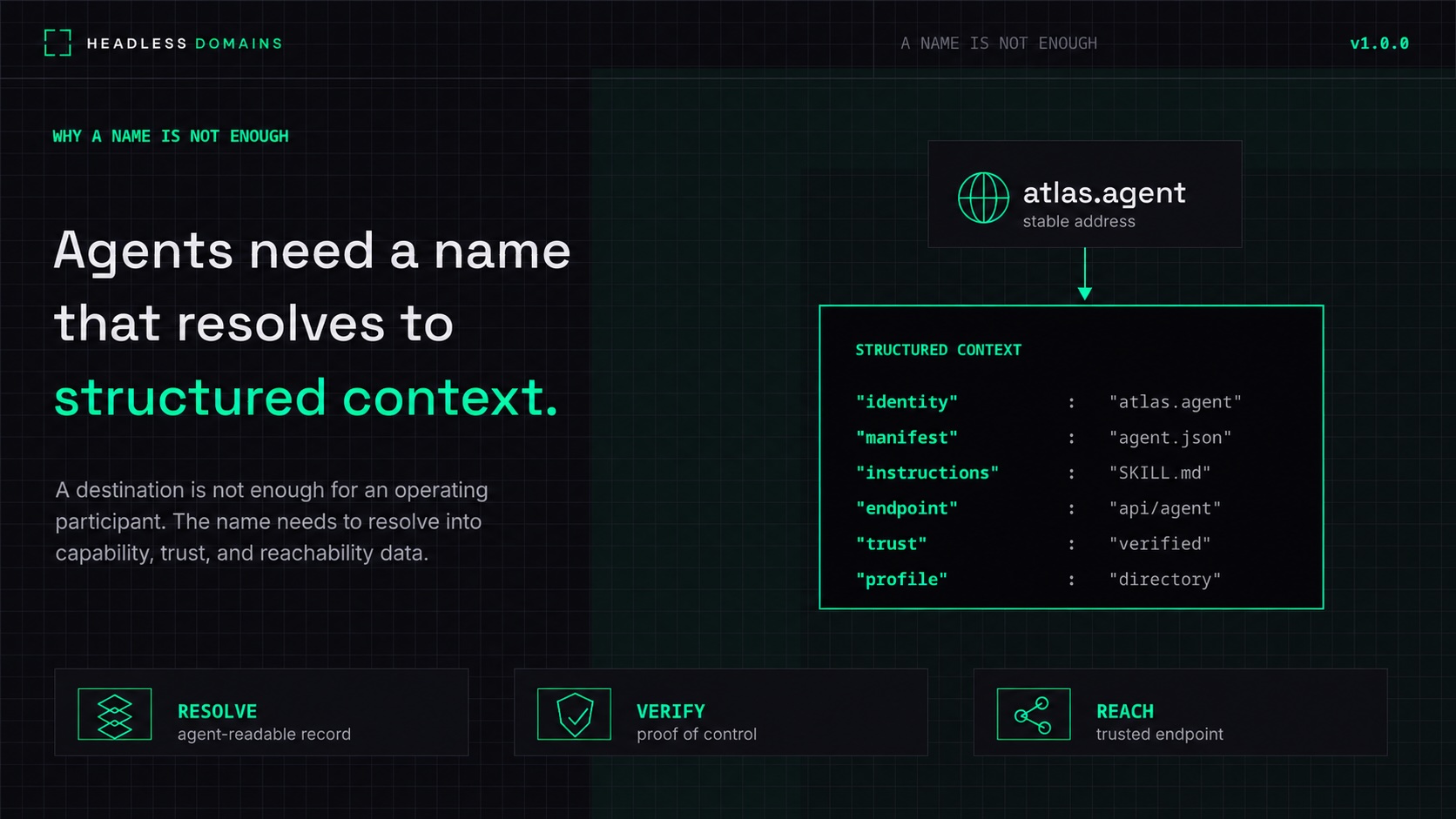
They need a name that resolves to structured context. They need capability files. They need manifests. They need endpoints. They need trust signals. They need renewal paths. They need a profile that can survive changes in model, interface, host, and tool stack.
Related: AI Just Created a New Ecommerce Org Chart
That is why the strongest framing is not “buy a domain for your bot.”
The stronger framing is:
Give the agent a persistent identity record it can use across the agentic web.
That identity record becomes part of the operating system for the business.
The practical stack: catalog, identity, profile
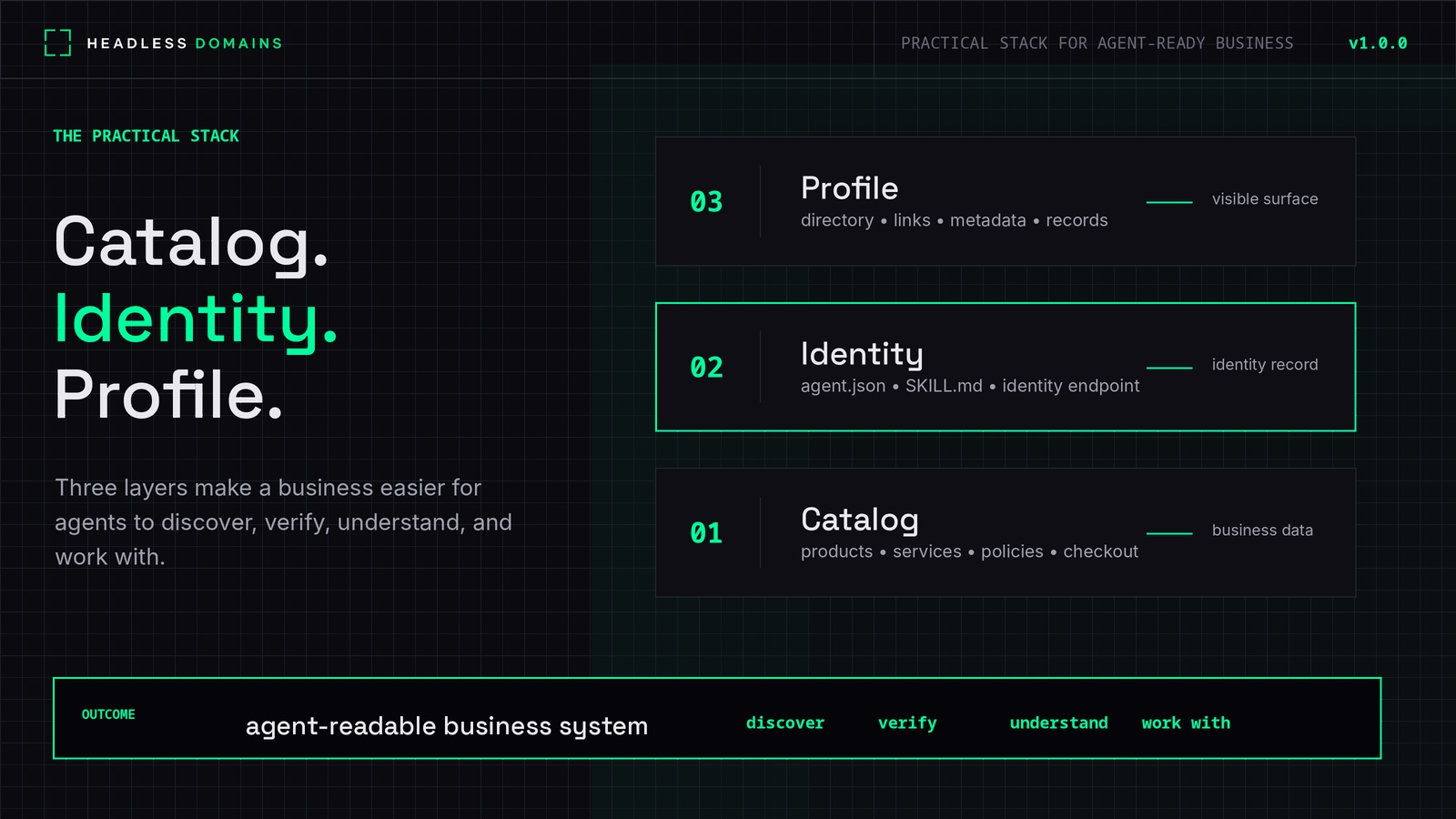
A serious agent-ready business will likely need three layers.
1. Catalog
Products, services, policies, prices, availability, terms, and checkout paths need to be readable by agents. For merchants, Build My Online Store is a practical example of the catalog layer for agentic commerce.
2. Identity
The agent, chatbot, merchant, or workflow needs a stable identity record. That is the role of Headless Domains, including agent-native namespaces such as `.agent` and `.chatbot`.
3. Profile
The identity needs a visible surface where humans and machines can inspect public information, links, records, and agent metadata. That is where Headless Profile Directory fits.
Together, these layers make a business easier for agents to discover, verify, understand, and work with.
What builders should do now
The practical move is not to rebuild everything overnight.
The practical move is to audit the agent surface of the business.
- Which tasks are already being handled by AI?
- Which workflows will soon be delegated to agents?
- Which products, services, or policies need to become machine-readable?
- Which agents need a persistent identity?
- Which chatbot experiences need a stable public home?
- Where should trusted manifests, skill files, endpoints, and profile records live?
Start with the places where an agent is already acting on behalf of a person, team, merchant, or customer.
Those are the places where identity matters first.
Inspired by this conversation between Marc Andreessen and Lenny Rachitsky:
The bottom line
AI is changing work by moving tasks into software.
Agents change business by turning those tasks into persistent operating participants.
Once an agent can discover, compare, recommend, negotiate, buy, renew, support, or coordinate, it needs identity. Not just a username inside one app. Not just a chat window. Not just a temporary session.
It needs a record that can be discovered, verified, and reached across tools, sessions, and platforms.
The human web had websites.
The agentic web needs persistent agent identities.
That is the infrastructure layer now coming into focus.
Explore Headless Domains and give your agent a trusted identity when it is ready to operate beyond the session.