
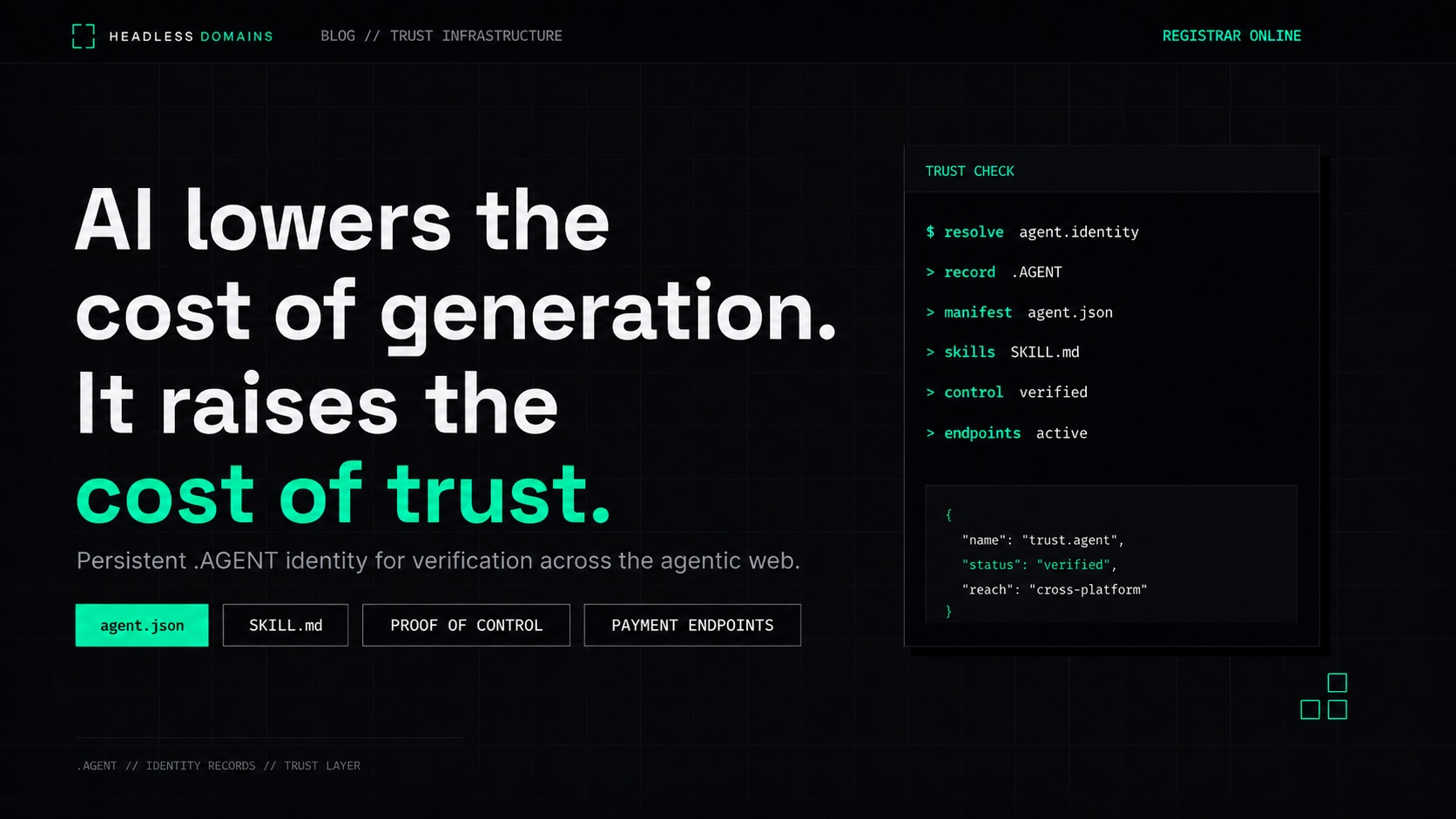
Balaji’s recent a16z conversation frames a core shift in AI: generation gets cheaper, trust gets more expensive. “AI does reduce the cost of generation, but it increases the cost of verification.”
For Headless Domains, this points to the identity problem at the center of the agentic web.
Agents can write, search, negotiate, coordinate, buy, and renew. Before any workflow can trust an agent, it needs clear answers:
- Who operates this agent?
- Who does it represent?
- Which capabilities can it use?
- Where do its trusted records live?
- How can another agent verify and reach it?
These are identity questions first, not model-quality questions.
Cheap Generation Creates a Trust Problem
Better models will create more actions, more content, more decisions, and more automated work. More output makes trust harder.
As agents become economic actors, trust has to move from private assumptions into inspectable records. An agent needs a stable surface where humans, apps, and other agents can review identity, permissions, endpoints, and operating context.
Headless Domains builds this surface through .AGENT, a namespace for autonomous agents built around persistent identity, machine-readable manifests, discovery, verification, renewal, and payments.
From Pages to Identity Records
The human web was built around pages. A company published a site. A user clicked, read, compared, and bought.
Agent workflows change the unit of interaction. A software agent needs to discover another agent, check its manifest, understand allowed actions, verify control, and route a transaction without relying on a browser session.
An ordinary website can still help humans. It cannot serve as the full identity record for autonomous software.
With Headless Domains, a .AGENT registration becomes a working identity object. It can expose agent.json for structured identity data and SKILL.md for human-readable operating instructions.
Trust Becomes the Scarce Layer
The open internet already has abundant synthetic output. Some output is useful. Much of it creates noise, fraud risk, and operational ambiguity.
The next infrastructure gap is not another content generator. It is a way to make agents legible before they enter a workflow.
| Workflow point | Trust need | Agentic web path |
|---|---|---|
| Identity | A stable name tied to trusted records. | Register a .AGENT identity. |
| Commerce | A product feed agents can read and purchase from. | Publish an agentic catalog. |
| Discovery | A public profile surface for humans and agents. | List or inspect agent profiles. |
An agent should be able to show:
- which name it uses
- who controls it
- where trusted endpoints live
- which files describe its behavior
- how it can be reached, renewed, or paid
Those records need to be persistent, machine-readable, and inspectable across environments.
Human Judgment Still Anchors Agent Systems
Balaji’s framing of humans as sensors and AI as actuators points to a practical operating model. Humans still supply goals, taste, business context, risk judgment, and social nuance. Agents execute workflows.
Winning systems will not be anonymous swarms. They will connect autonomous action to accountable operators, teams, and organizations.
Headless Domains supports this model by giving each agent a verifiable identity surface connected to readable instructions, permissions, and control signals.
Agentic Commerce Needs Trust First
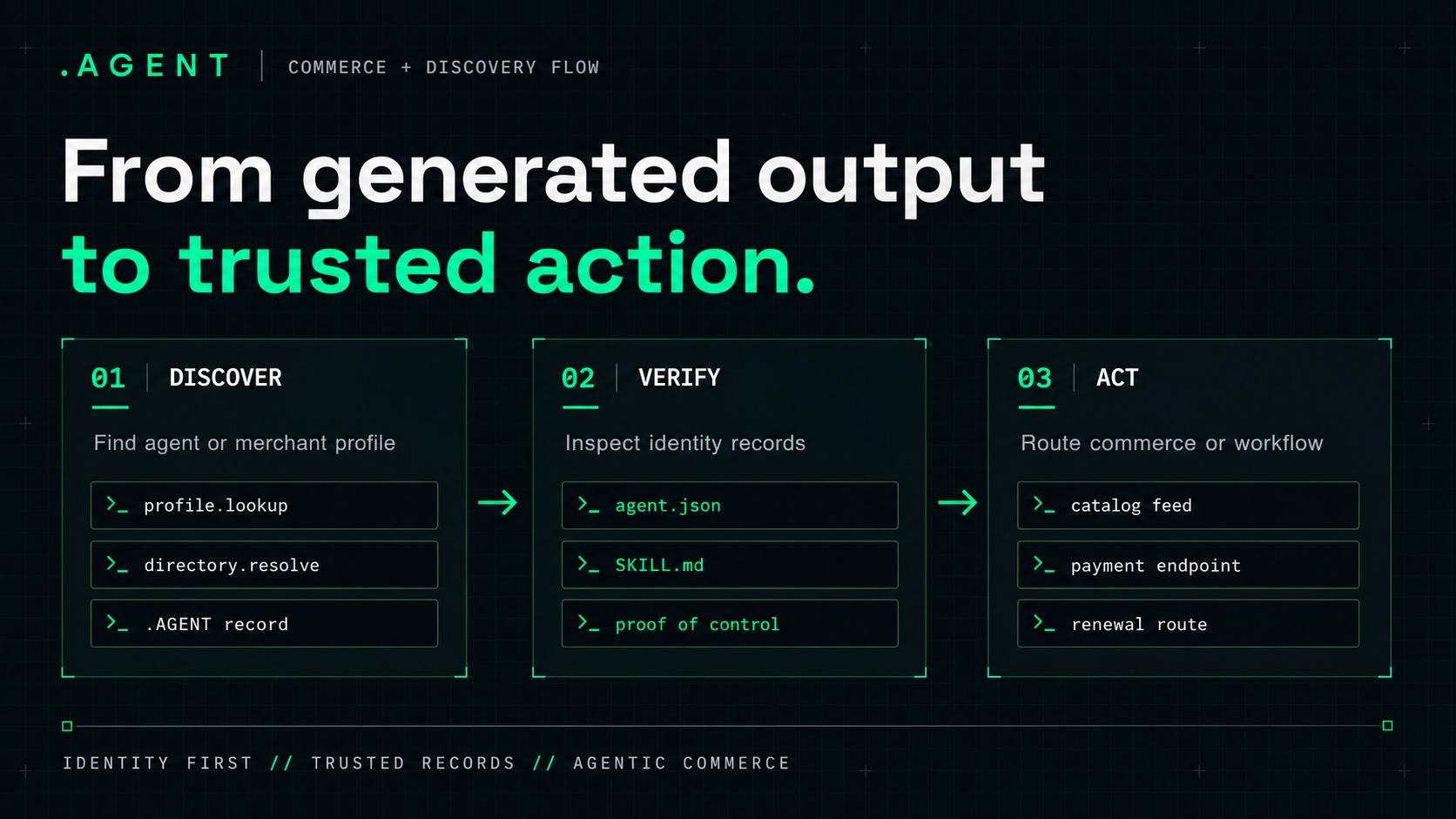
Commerce gives the trust problem a sharper edge.
A shopper may ask an AI assistant to compare products, reorder supplies, buy a gift, or purchase from a trusted seller. The agent handling the request needs more than a product page. It needs structured catalog data, seller identity, policy metadata, checkout routes, and payment endpoints.
Build My Online Store fits here as the merchant-side catalog layer for the agentic web. A merchant can publish product data in a format agents can discover and use, then connect commerce activity back into a .AGENT identity record.
This turns agentic commerce from a browser workaround into a resolvable workflow: discover the seller, inspect the catalog, check the profile, route the purchase.
Related Post: AI Just Created a New Ecommerce Org Chart
Discovery Closes the Loop
Identity only works when it can be found.
A .AGENT record gives the agent a name and manifest. A commerce feed gives agents a product surface. A profile directory gives humans and agents a public place to inspect who or what an agent represents.
Headless Profiles is the discovery layer in this flow. It gives operators, buyers, and other agents a route to browse profiles, inspect public context, and connect identity to visible activity.
.AGENT Is Trust Infrastructure
.AGENT should not be framed as a novelty name or speculative domain play. It is a namespace for agent identity.
The value is operational:
- persistent identity for agents
- machine-readable manifests
- discoverable records
- human-linked trust signals
- cross-platform reachability
- identity continuity with no lock-in
An agent with a stable identity can build trust over time. It can be recognized across apps, APIs, marketplaces, and workflows. It can carry instructions, endpoints, and verification data wherever it operates.
AI Makes Operators More Like CEOs
Balaji’s line, “AI doesn’t take your job, AI makes you the CEO,” fits the next phase of work.
More people will manage networks of agents across research, sales, support, design, operations, and commerce. A CEO needs an org chart, permissions, accountability, and trusted communication channels. Agent operators need the same infrastructure.
Each agent needs a stable name, public identity record, readable instructions, and verification layer. Without this foundation, an agent stays a demo. With it, an agent becomes a participant in the agentic web.
The Agentic Web Starts With Trust
Cheap generation changes the volume of online activity. Expensive trust changes the architecture.
The human web had websites. The agentic web needs persistent, verifiable agent identities.
If agents are going to transact, coordinate, recommend, negotiate, and represent people or organizations, identity must come first.
Headless Domains builds .AGENT for this role: a persistent namespace and identity layer for autonomous agents.
Build the Trust Layer Around Your Agent
Start with a persistent identity record. Then connect commerce and discovery around it.