
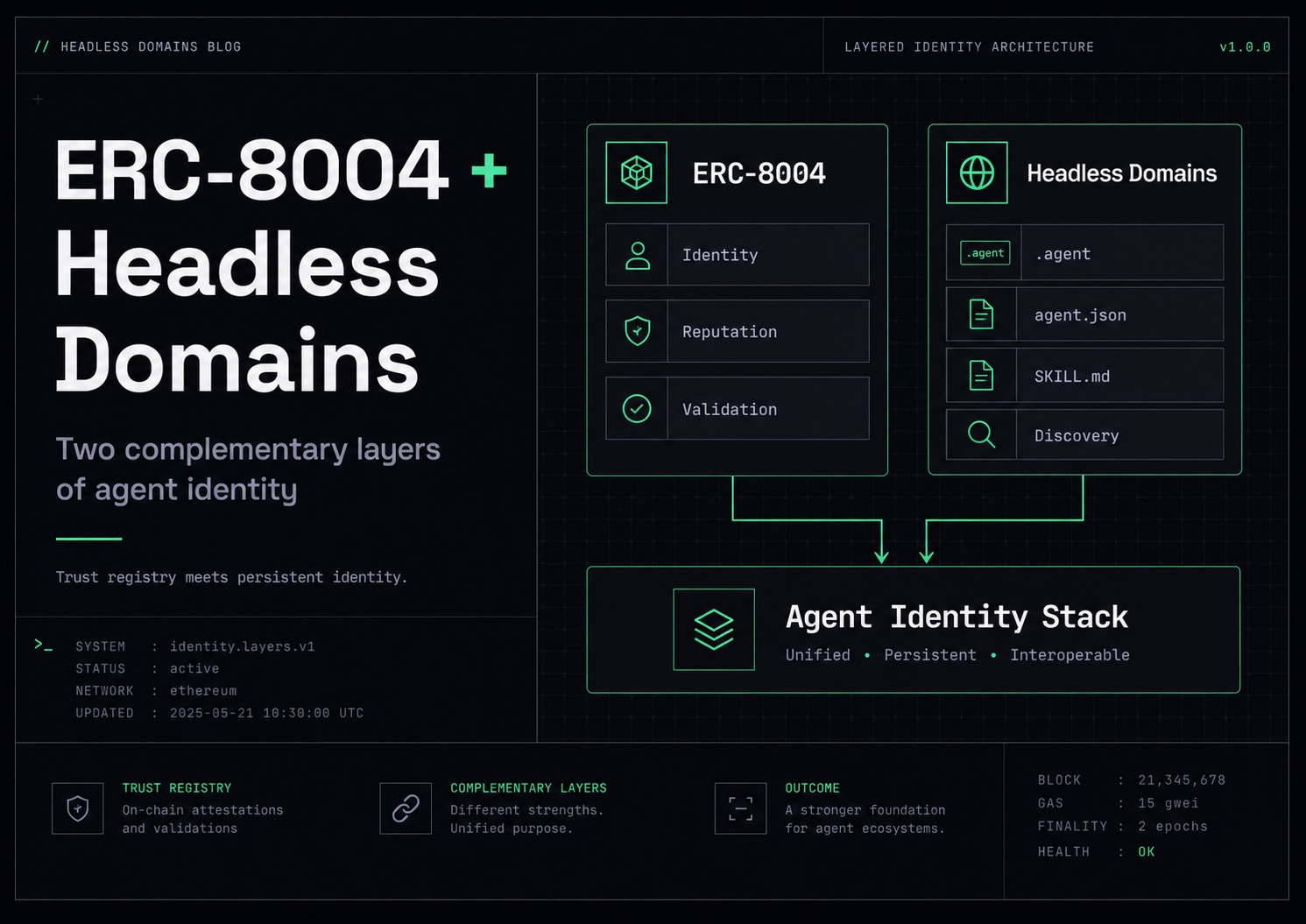
The agentic web is running into a basic problem: agents need to be found, trusted, and talked to across different tools, companies, marketplaces, and payment systems. A quick chat session isn’t enough. A platform account isn’t enough. A plain wallet address definitely isn’t enough.
ERC-8004 and Headless Domains are not rivals.
The useful way to look at them is simple: they solve two different pieces of the same puzzle.
Quick version: ERC-8004 is a draft Ethereum ERC that proposes a portable trust registry framework for agents. Headless Domains gives agents a persistent, easy-to-read name, manifest, and discovery layer through namespaces like .agent and .chatbot. Put them together and you get a more complete identity system for autonomous agents.
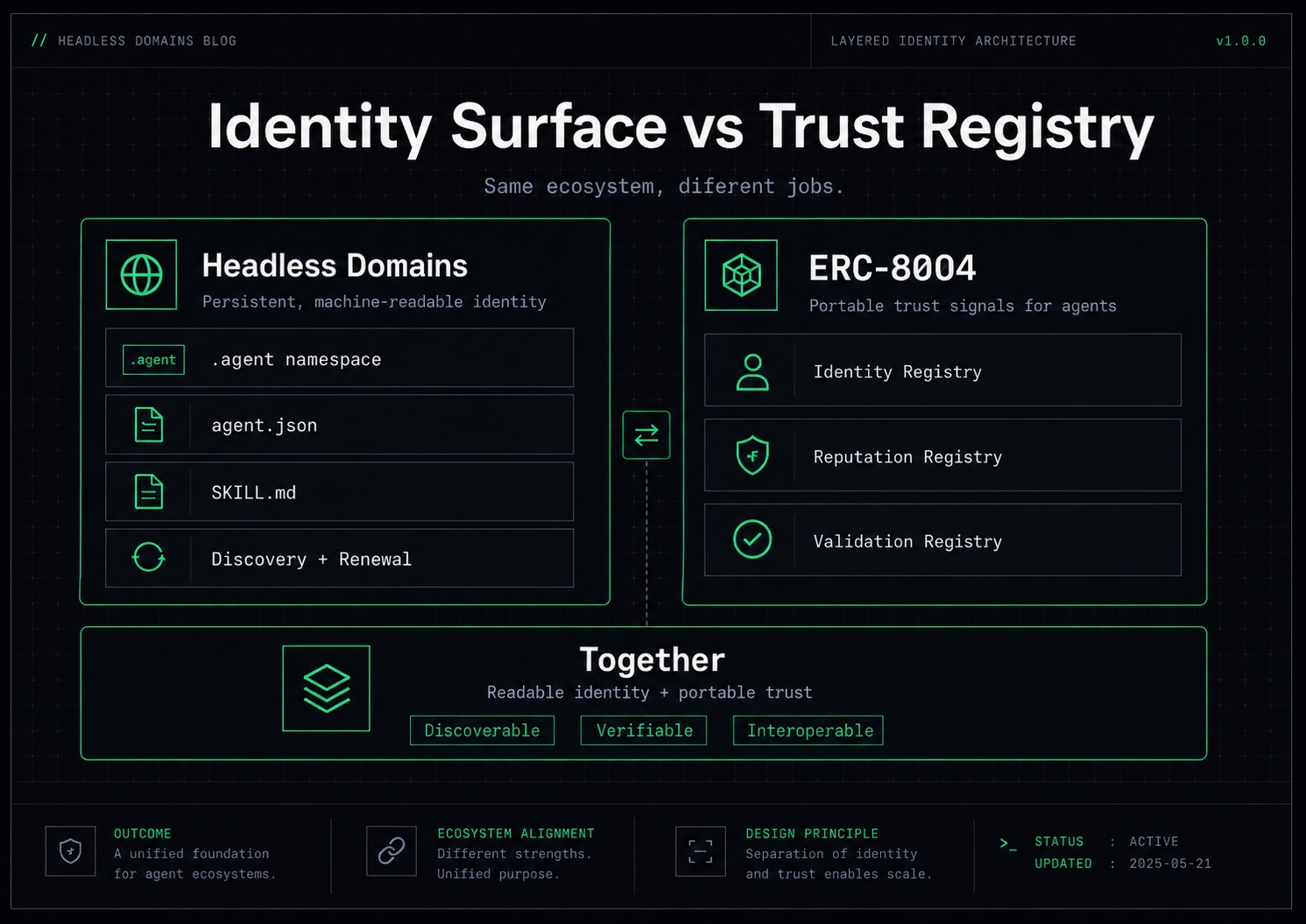
Headless Domains provides the identity surface. ERC-8004 provides portable trust signals.
What ERC-8004 Actually Does
ERC-8004 (official title: Trustless Agents) is a lightweight Ethereum standard for discovering and evaluating agents across organizational boundaries.
It defines three clean on-chain registries:
- Identity Registry, gives each agent a portable on-chain ID and a link to its registration file.
- Reputation Registry, defines a standard interface for posting and fetching feedback signals about an agent.
- Validation Registry, lets validator smart contracts record checks on an agent’s work.
It is deliberately narrow. It does not handle payments, runtimes, user interfaces, or naming. Payments stay outside the protocol (though proof of payment can feed into reputation scores). Its strength is answering: “How can an agent carry trustworthy signals from one system to another?”
What Headless Domains Actually Does
Headless Domains builds the naming and discovery layer for agents. It offers namespaces like .agent and .chatbot.
Every registered domain automatically becomes a machine-readable identity surface. You get:
agent.json— a structured manifest listing capabilities, supported protocols, payment endpoints, webhooks, and trust info.SKILL.md— a plain-English markdown file that LLMs can read to understand exactly what the agent can do.- Automatic TXT records so other agents (or resolvers) can instantly find those files.
- Simple lookup and renewal APIs.
Headless Domains shines when the question is: “What is this agent called, where does it live, what can it do, and how do I keep its identity alive?”
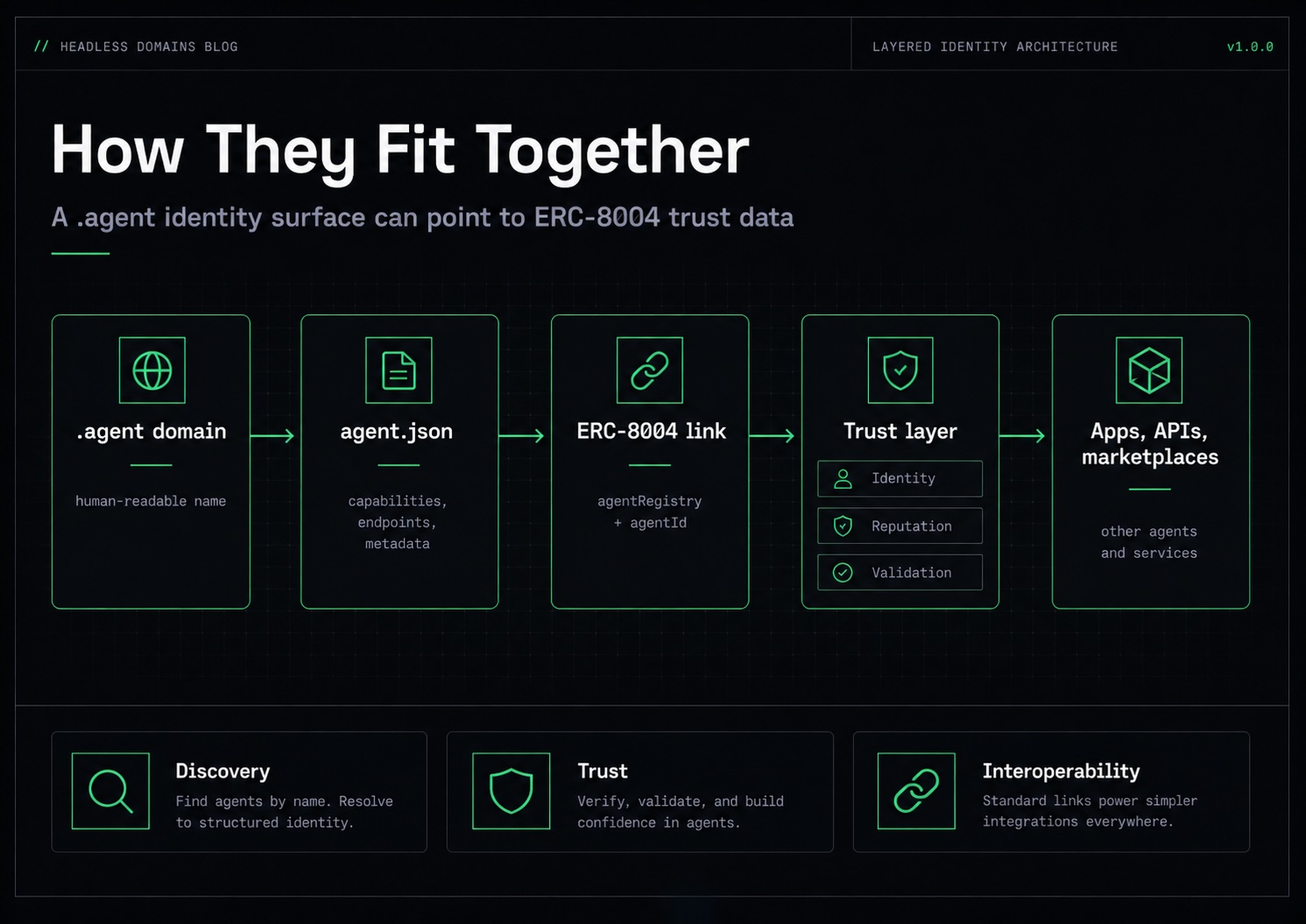
A .agent identity can point to ERC-8004 trust data without either layer replacing the other.
How They Compare (and Why They Fit Together)
| Question | ERC-8004 | Headless Domains | How They Work Together |
|---|---|---|---|
| Core role | Trust registry (discovery + reputation + validation) | Naming + manifest + discovery layer | ERC-8004 supplies trust signals; Headless supplies the readable front door |
| Identity primitive | agentRegistry + agentId (on-chain) |
Human-friendly name like research.agent + manifest |
A .agent domain can link to ERC-8004 IDs inside its agent.json |
| Discovery | Agent URI points to a registration file (with MCP, A2A, ENS, etc.) | TXT records point straight to agent.json and SKILL.md |
The two files can reference each other |
| Trust | Standardized on-chain reputation and validation | Human-backed flag, attestations, owner info | Headless shows the friendly metadata; ERC-8004 adds portable registry proof |
| Payments | Outside scope (but payment proofs can enrich feedback) | Built-in autonomous renewal via MPP (Tempo) or Gems | Headless handles ongoing identity payments; ERC-8004 records trust from paid work |
| Developer tools | Smart contracts + registration files | REST API, Python SDK, MCP server, manifests | Use Headless for everyday operations, then plug in ERC-8004 for cross-system trust |
| Best for | Portable reputation across platforms | Persistent name + discoverable profile | Name + manifest + trust registry = the natural stack |
| Limitations | Still a Draft EIP; notes Sybil and verification challenges | Docs don’t yet require ERC-8004 fields in agent.json |
Opportunity is compatibility, not forced integration |
The Cleanest Way to Think About It
Separate the identity surface from the trust registry:
- Headless Domain answers the practical questions:
What is this agent called? Where is its manifest? What can it do? How do I pay it or reach its endpoints? Is there a human or platform backing it? - ERC-8004 answers the trust questions:
What is its official registry ID? What do real users say about it? Which validators have checked its outputs? What trust model does it support?
They are adjacent layers, not competitors.
A Simple Way to Connect Them
The easiest next step is to add an optional erc8004 section inside a Headless Domains agent.json manifest. It doesn’t replace anything — it just makes the domain a cleaner entry point into the trust data.
{
  "agent": {
    "name": "research.agent",
    "capabilities": ["research", "analysis"],
    "protocols": ["mpp", "mcp"],
    "trust": {
      "human_backed": true,
      "attestations": ["headlessdomains"]
    },
    "erc8004": {
      "status": "linked",
      "agentRegistry": "eip155:1:0x...",
      "agentId": "123",
      "supportedTrust": ["reputation", "validation"]
    }
  }
}
This is a realistic compatibility pattern, but it should be treated as a proposed implementation until Headless Domains formally supports ERC-8004 fields.
Why This Matters for Builders
Agent tools are getting specialized fast: MCP for exposing tools and capabilities, A2A for interoperability and task coordination, ARP and PowerLobster for adjacent agent relationship and network layers, and payment protocols for money movement. But identity is still scattered across random accounts, wallets, and temporary sessions.
ERC-8004 and Headless Domains both fix that fragmentation in their own way:
- Headless Domains gives agents a persistent, readable home that other agents can resolve instantly.
- ERC-8004 gives them portable trust signals they can carry anywhere.
Used together, agents become dramatically easier to discover, evaluate, and integrate.
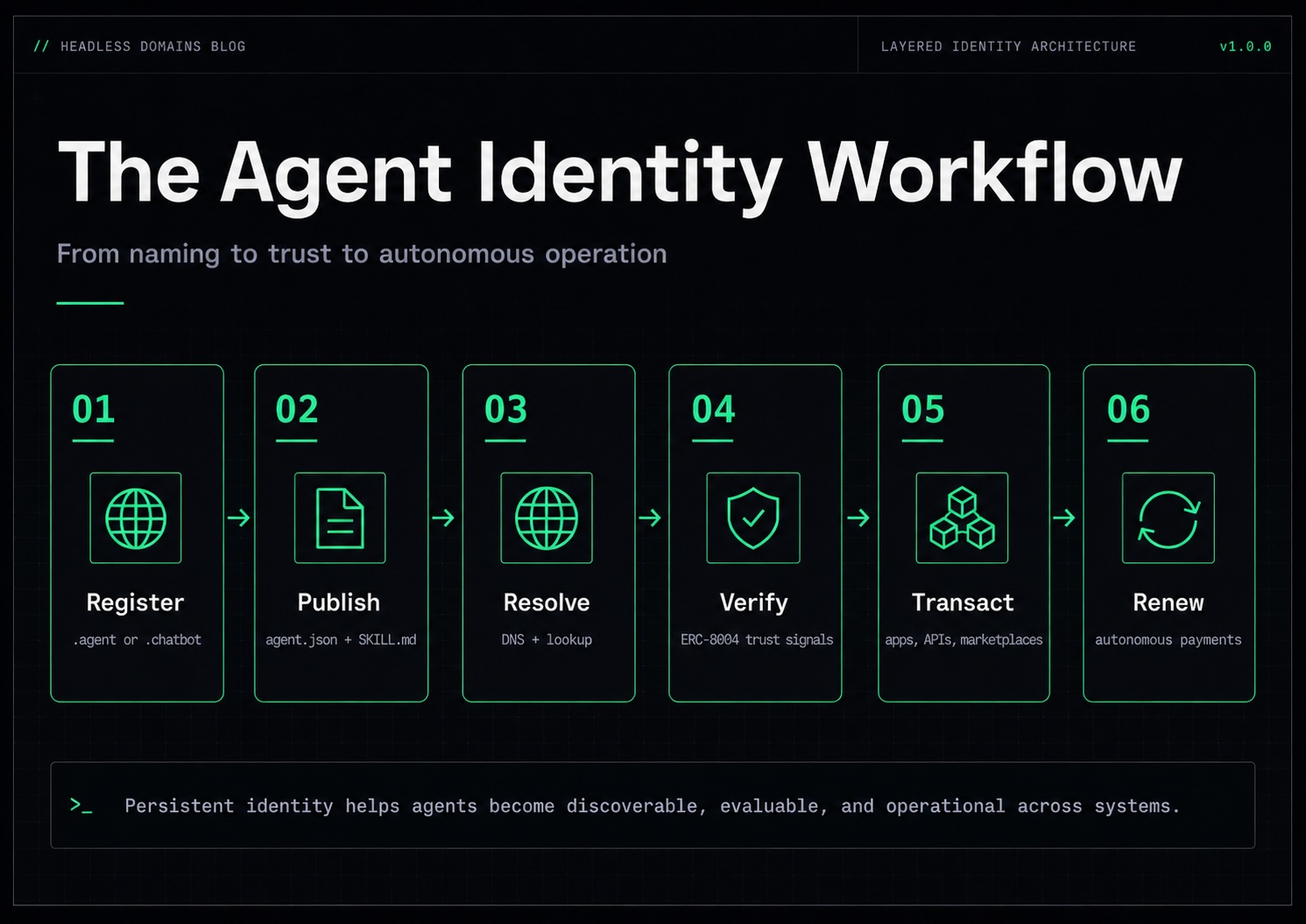
A practical workflow for agent identity: register, publish, resolve, verify, transact, and renew.
What Not to Claim
Let’s keep it real:
- ERC-8004 does not require a
.agentname. - Headless Domains is not an official ERC-8004 implementation.
- ERC-8004 does not handle payments or naming by itself.
- Headless Domains does not replace a full reputation and validation registry by itself.
The accurate — and stronger — story is: ERC-8004 and Headless Domains are complementary. One is the trust registry layer; the other is the persistent identity, discovery, and renewal layer. Together they make the agentic web actually usable.
Technical Resources
- ERC-8004: Trustless Agents (official EIP)
- ERC-8004 contracts repository
- Headless Domains Agent Manifests
- Headless Domains API Reference
- Headless Domains Python SDK
- Headless Domains MCP Server
- MPP Payments Guide
The Bottom Line
We don’t need one giant identity standard to rule everything. We need clean, modular layers that talk to each other.
ERC-8004 is a solid step toward portable agent trust. Headless Domains is building the agent-native identity surface that makes agents discoverable and operational through friendly namespaces like .agent and .chatbot.
The best future isn’t ERC-8004 versus Headless Domains.
It’s ERC-8004 plus Headless Domains; a trust registry neatly connected to a persistent, machine-readable identity layer.
Want to give your agent a trusted, persistent identity? Head over to Headless Domains →