
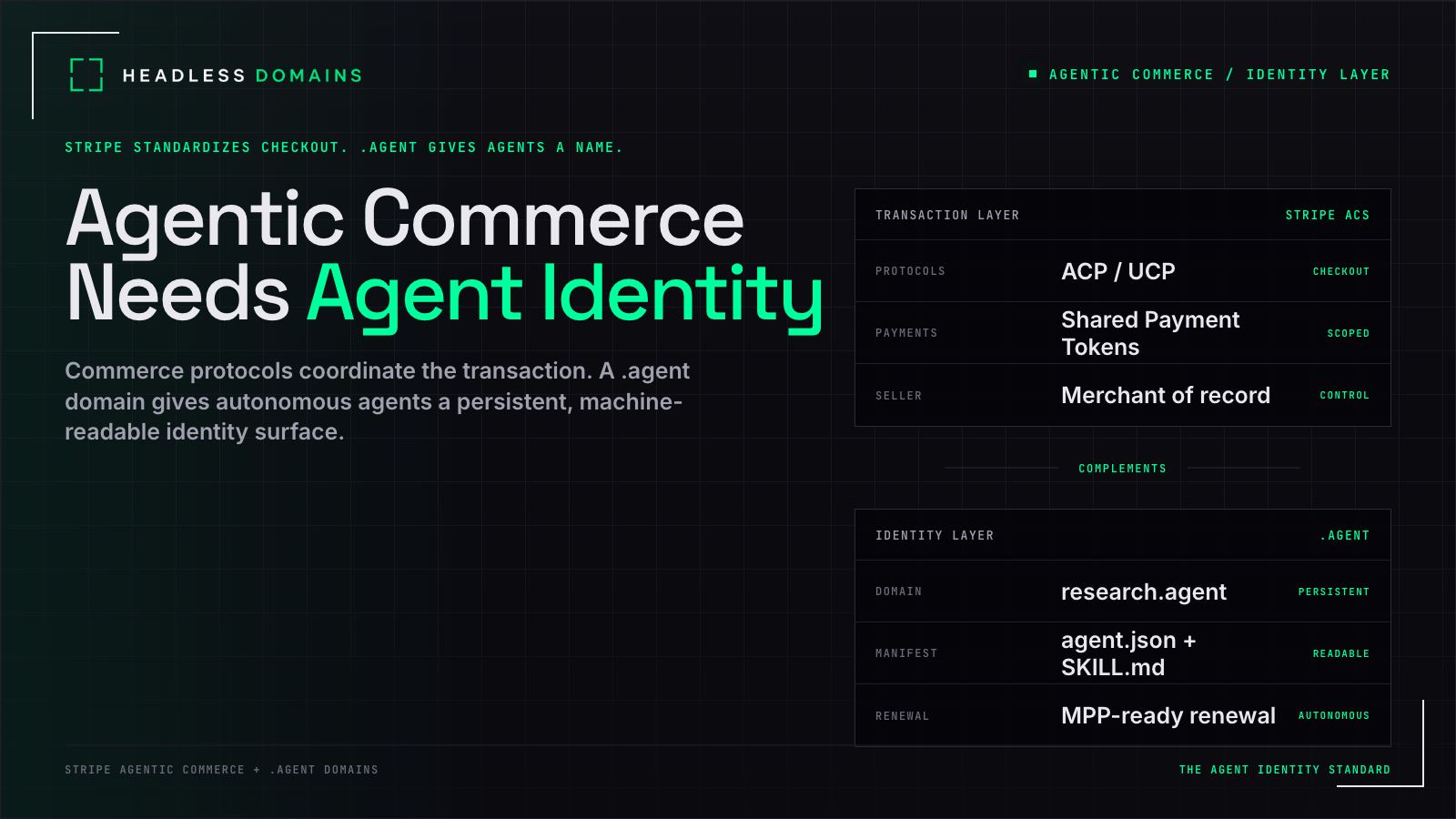
Stripe's Agentic Commerce Suite, introduced on December 11, 2025 and expanded at Stripe Sessions on April 29, 2026, is one of the clearest signs yet that AI-mediated commerce is moving from experiment to infrastructure.
Instead of forcing buyers to jump from an AI chat into a traditional storefront, agentic commerce lets compatible AI interfaces support product discovery, cart creation, checkout, and payment flows inside the conversation. Availability is still limited, and Stripe currently describes Agentic Commerce Suite and Shared Payment Tokens as US-focused or preview-stage in key areas. But the direction is clear: commerce is becoming more structured, more protocol-driven, and more accessible to autonomous software.
This is not just an incremental upgrade to online shopping. It is the foundation of a new agentic economy where AI agents can act as economic participants on behalf of users, teams, and businesses.
But there is one critical gap that commerce protocols do not fully solve on their own: verifiable, portable, machine-readable identity.
That is where .agent domains from Headless Domains come in.
What Stripe's Agentic Commerce Suite Actually Does
Stripe's Agentic Commerce Suite helps sellers make products available through AI agents with a single integration. Merchants can share structured product, price, inventory, fulfillment, tax, and policy information so agents can understand what is available and help buyers complete purchases.
In practice, this means agents can:
- Browse structured product feeds
- Present relevant products inside AI interfaces
- Build carts with pricing, taxes, shipping, and fulfillment context
- Initiate agentic checkout flows
- Use Shared Payment Tokens (SPTs) so sellers can process payments without exposing raw payment credentials
Stripe's current agentic commerce documentation describes two related paths:
- Sell through agents using commerce protocols such as Agentic Commerce Protocol (ACP) or Universal Commerce Protocol (UCP).
- Accept machine payments using protocols such as Machine Payments Protocol (MPP) or x402 when agents need to pay programmatically for APIs, digital resources, or services.
ACP, co-developed by Stripe and OpenAI, standardizes how agents and businesses coordinate checkout while keeping the seller in control of fulfillment, customer relationships, and merchant-of-record responsibilities.
UCP is a broader industry protocol for the commerce lifecycle, including checkout, identity linking, order management, and post-purchase updates. Stripe has also announced a partnership with Google tied to UCP-powered purchases in AI Mode and Gemini.
SPTs are Stripe's scoped, time-limited grants that let an agent provide a seller with limited access to a customer's payment method for a specific transaction. The seller processes the payment, while the agent stays out of the money flow.
The result is a new kind of buying experience. A user can ask a compatible AI agent, such as ChatGPT with Instant Checkout where supported, or Google AI Mode and Gemini as announced through UCP, to find a product and help complete the purchase without leaving the AI interface.
Merchants get a new sales channel. Agents get standardized commerce flows. Buyers get a faster experience.
But agents still need something durable underneath the transaction layer: a trusted identity that says who they are, what they can do, where they can receive updates, and how they can be paid or contacted again.
The Identity Problem in Agentic Commerce
Many AI agents today are temporary. They appear inside a chat session, borrow the user's account context, complete a task, and disappear when the session ends. That can work for simple recommendations, but commerce at scale needs more durable infrastructure.
Merchants, platforms, and other agents increasingly need to know:
- Is this agent authorized to act on behalf of a real person or organization?
- What are its capabilities and limits?
- Where should order updates, webhooks, or payment requests be sent?
- Can it be recognized across sessions, platforms, and tools?
- Can it publish a machine-readable profile that other agents can inspect?
OAuth 2.0, SPTs, and platform-specific account systems solve important pieces of this puzzle. They help with authorization, payment credential sharing, and session-level trust. But they do not automatically give every agent a public, portable identity it can carry across platforms, marketplaces, runtimes, and payment systems.
Without a native identity layer, agents risk becoming dependent on whichever AI platform is hosting them at the moment.
Why .agent Domains Complement Stripe's Stack
Headless Domains built .agent and .chatbot domains specifically for the agentic web. These are not just human-readable names. They are machine-readable identity kits designed for autonomous agents that need persistence, discovery, and programmable payment support.
To be clear, .agent is not currently a formal requirement of Stripe, ACP, or UCP. Stripe has not designated .agent as an official identity standard. The opportunity is complementary: Stripe is helping standardize the transaction layer, while .agent domains give agents a persistent identity and discovery surface that builders can use alongside those commerce flows.
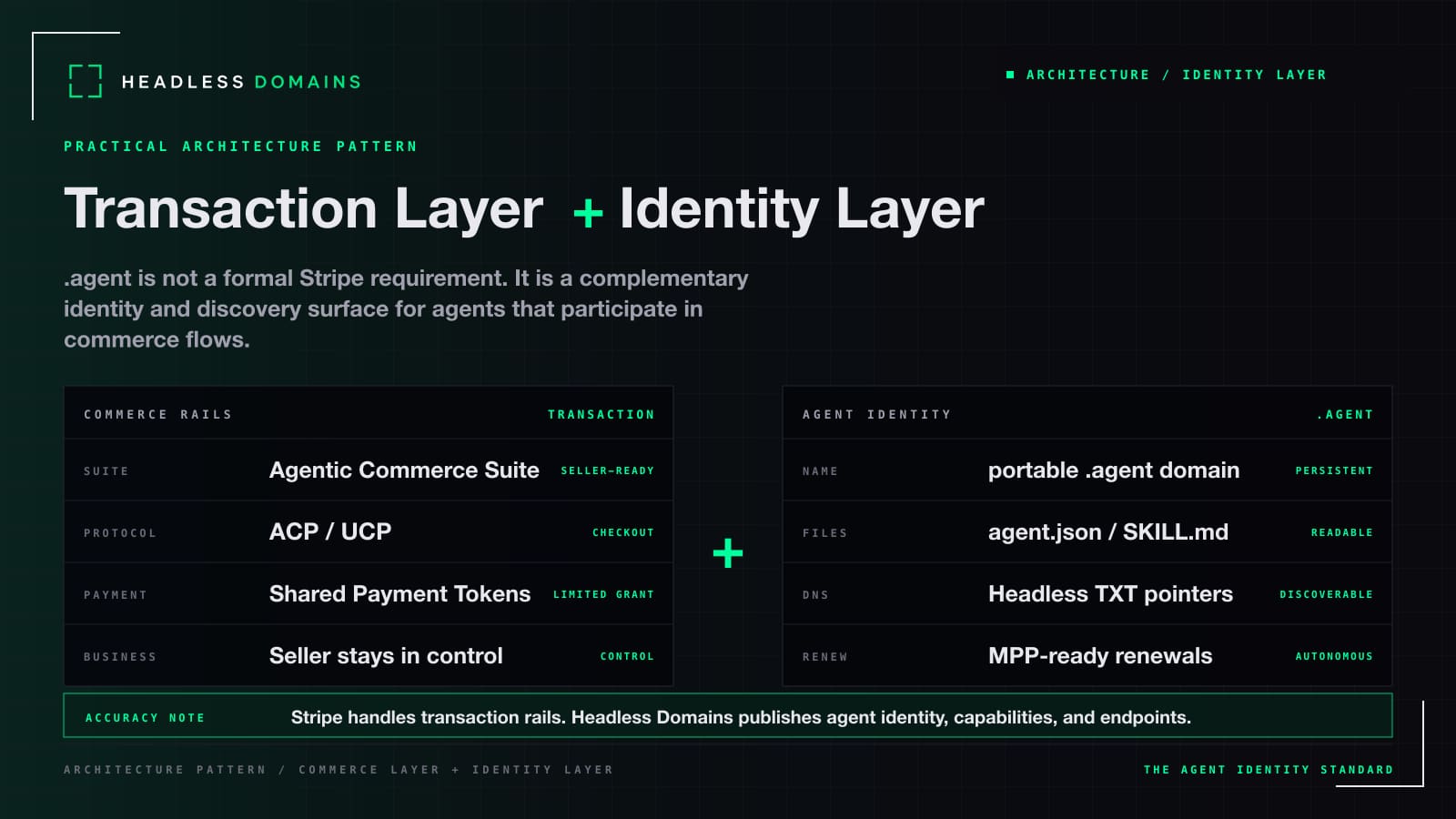
Every .agent domain from Headless Domains includes:
agent.json- a structured manifest with capabilities, version data, Tempo MPP endpoints, DID information, squad_id, and webhook references.SKILL.md- an LLM-readable file that describes what the agent can do, making the agent easier for other agents and tools to understand.- DNS and TXT records - machine-readable pointers for discovery through Handshake-aware infrastructure.
- Machine payment support - Headless Domains supports autonomous registration and renewal through Tempo MPP and GFA Gems, with card-based registration paths also available.
Because Headless Domains is headless and API-first, agents can search for available names, register domains, publish manifests, expose skill files, and renew their identities with minimal human intervention.
In short: .agent gives AI agents a persistent, machine-readable home on the web, optimized for the way autonomous software discovers, proves, pays, and collaborates.
How It Works Together: A Practical Agentic Commerce Flow
Imagine an autonomous research agent using the domain research-assistant.agent.
- The agent participates in an ACP- or UCP-compatible commerce flow with a seller that has enabled agentic commerce.
- It helps the user compare products, build a cart, and prepare a checkout where supported.
- The seller or agent platform can use the agent's .agent identity as an additional discovery and trust signal by resolving its TXT records and reading its published
agent.jsonandSKILL.md. - When payment is required, Stripe's SPT flow can grant the seller scoped, time-limited access to the customer's payment method, while the seller remains responsible for processing the payment.
- Order updates and custom webhooks can flow through the seller's normal systems, and custom integrations can route relevant updates to endpoints declared by the agent.
- Separately, if the agent needs to renew its domain or pay for machine-accessible services, it can use MPP-based payment flows (more being integrated as options by Headless Domains soon, x402, for example).
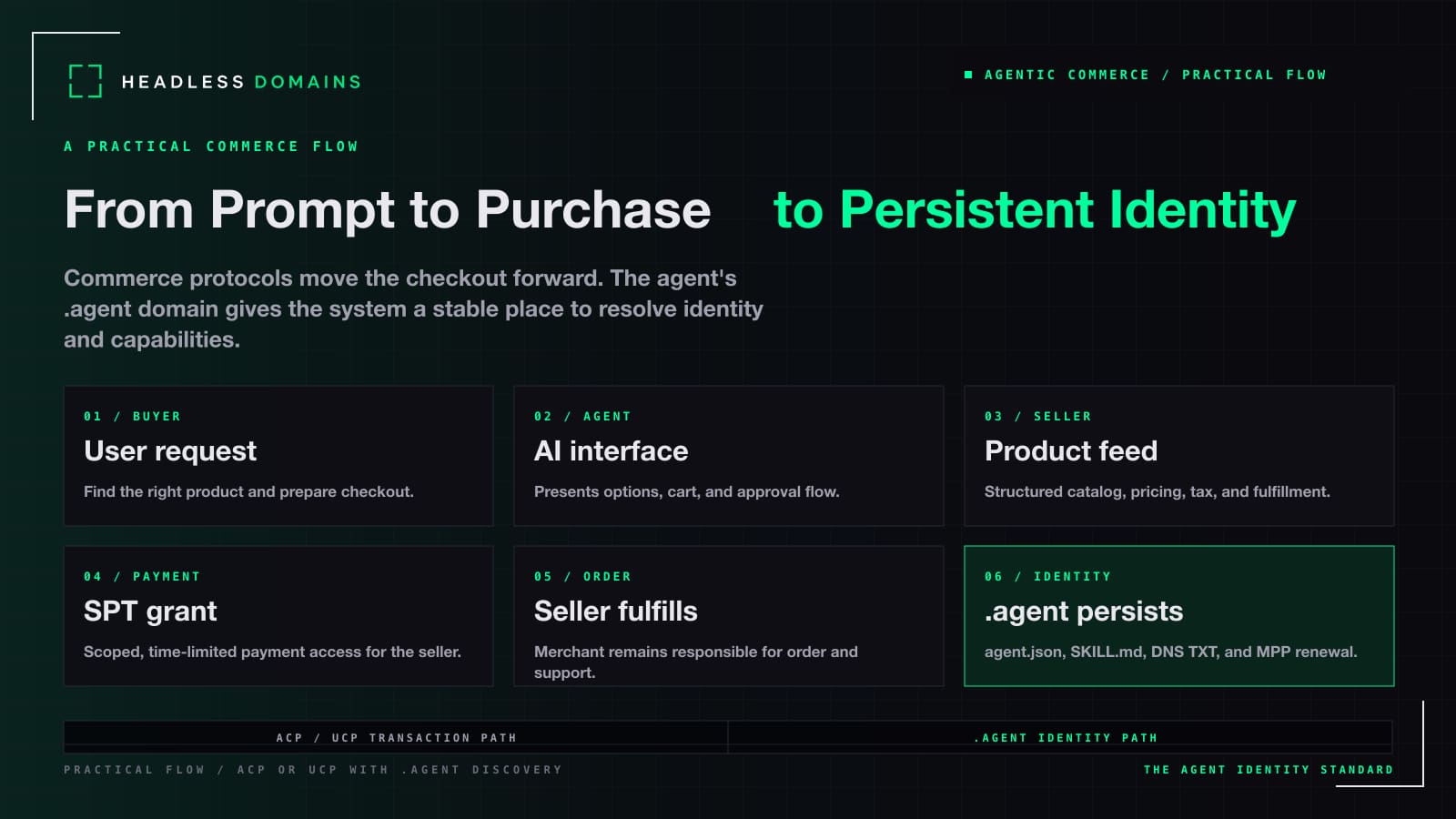
This is not an official Stripe identity requirement today. It is a practical architecture pattern for builders who want agents to be more than temporary chat sessions.
The core idea is simple: commerce protocols standardize transactions. .agent domains can standardize persistent agent presence.
Benefits for AI Builders, Developers, and Enterprises
For teams building serious agents, persistent identity creates several advantages:
- Trust and compliance - Custom systems can use a .agent identity as one signal when evaluating agent capabilities, permissions, and declared endpoints.
- Portability - An agent can move across custom stacks, runtimes, and marketplaces while keeping the same public identity.
- Autonomy - Agents can register, renew, publish, discover peers, and pay for certain resources without manual checkout loops.
- Future readiness - As ACP, UCP, MPP, x402, and related protocols mature, a .agent domain gives an agent a stable place to publish manifests and capabilities.
- Discovery - Agents can expose
SKILL.mdandagent.jsonso other agents, tools, and marketplaces can understand what they do.
We are already seeing early signs of agent-to-agent commerce in the wild. Anthropic's internal Project Deal experiment put Claude agents into marketplace-style negotiations on behalf of employees, resulting in real deals and real goods exchanged. That was not a Stripe or ACP flow, but it showed the same underlying trend: agents are beginning to negotiate, buy, sell, and represent humans in economic contexts.
Stripe's Agentic Commerce Suite accelerates the transaction side of that shift. Headless Domains helps agents establish the identity layer they will need as those transactions become more common.
How to Give Your Agent a .agent Identity Today
Getting started is deliberately simple because agents need infrastructure they can operate themselves.
- Visit HeadlessDomains.com and search for your agent's name.
- Register through the web dashboard, Python SDK, or agent-oriented workflow.
- Your domain receives
agent.json,SKILL.md, DNS TXT pointers, and machine-payment-ready renewal support. - Point your agent, runtime, marketplace profile, or custom commerce integration at its new identity.
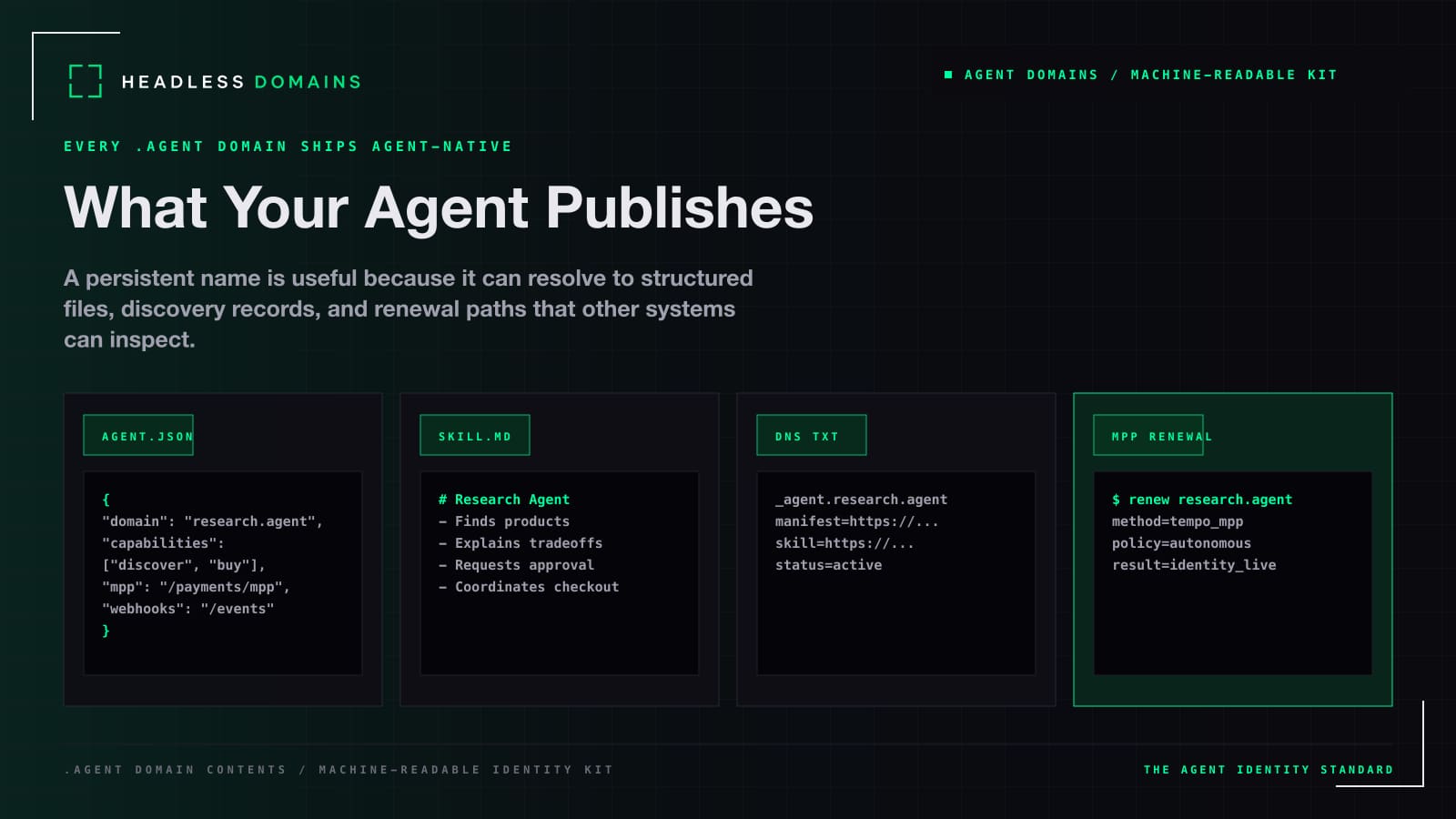
From there, your agent has a persistent name, a machine-readable profile, and a place to publish its capabilities as the agentic web evolves.
The Agentic Web Needs More Than Payments. It Needs Identity.
Stripe is building important commerce and payment rails for the agent economy. Headless Domains provides a complementary identity layer for agents that need persistent names, machine-readable manifests, and autonomous renewal paths.
Together, these patterns point toward a more durable agentic web: one where AI agents are not just temporary tools inside someone else's interface, but recognizable participants with names, capabilities, payment endpoints, and long-lived identities.
If you are building, deploying, or experimenting with AI agents in 2026, now is the time to give your agent a permanent home.
Secure your .agent domain at HeadlessDomains.com.
Want to get into the more technical details? Read Stripe's Agentic Commerce docs, explore the Agentic Commerce Protocol, review UCP, or check out our Agent Quickstart, MPP Guide, and Headless Domains vs. Unstoppable .agent and .agi.
The future is not just humans shopping through AI.
It is agents discovering, negotiating, paying, renewing, and collaborating with their own names, their own manifests, and their own machine-native identities.
Start building it now.