
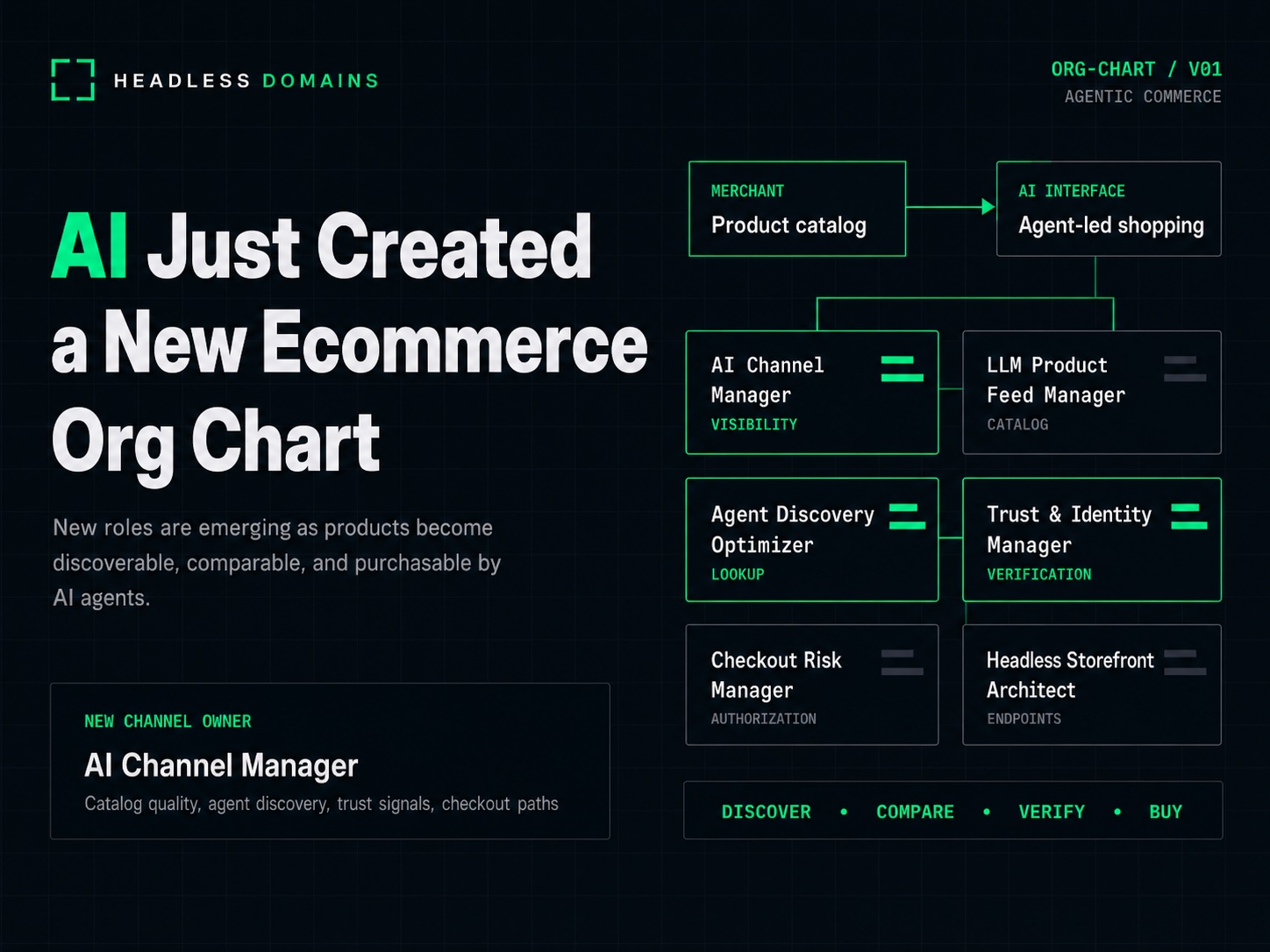
Ecommerce used to have a familiar operating model. A merchant needed a storefront, a product feed, search visibility, paid traffic, email flows, conversion optimization, checkout, fulfillment, and support.
That model is not going away. But it is no longer enough.
The next ecommerce channel is not another marketplace tab or social app. It is the AI interface itself. Customers are beginning to ask ChatGPT, Claude, Gemini, Grok, and other AI systems what to buy, which products to compare, where to find them, and in some cases how to complete the purchase.
That shift creates a new kind of ecommerce work. Merchants now need to think about product data, agent-readable catalogs, machine-ready checkout paths, trust signals, identity records, and AI-agent discoverability.
In other words, AI is creating a new ecommerce org chart.
The new sales channel is not a website. It is an agent.
For years, ecommerce teams optimized for humans clicking through pages. Product pages had to be readable, fast, persuasive, and indexed by search engines.
The agentic, post-browser web changes the question.
Instead of asking, “Can a human understand this product page?” merchants also need to ask:
- Can an AI agent discover this product?
- Can it understand the price, variants, availability, shipping rules, return policy, and checkout path?
- Can it compare this product against alternatives?
- Can it identify whether the seller is legitimate?
- Can it complete or route the transaction without forcing the buyer back into a traditional browser flow?
That is why tools like Build My Online Store matter. The product points toward a practical merchant need: publish a structured catalog once, then make products discoverable and purchasable in the AI channels where buyers are already starting to shop.
This is not just a product feed problem. It is an operating model problem. The ecommerce team needs new responsibilities, new owners, and new metrics.
The new AI ecommerce roles
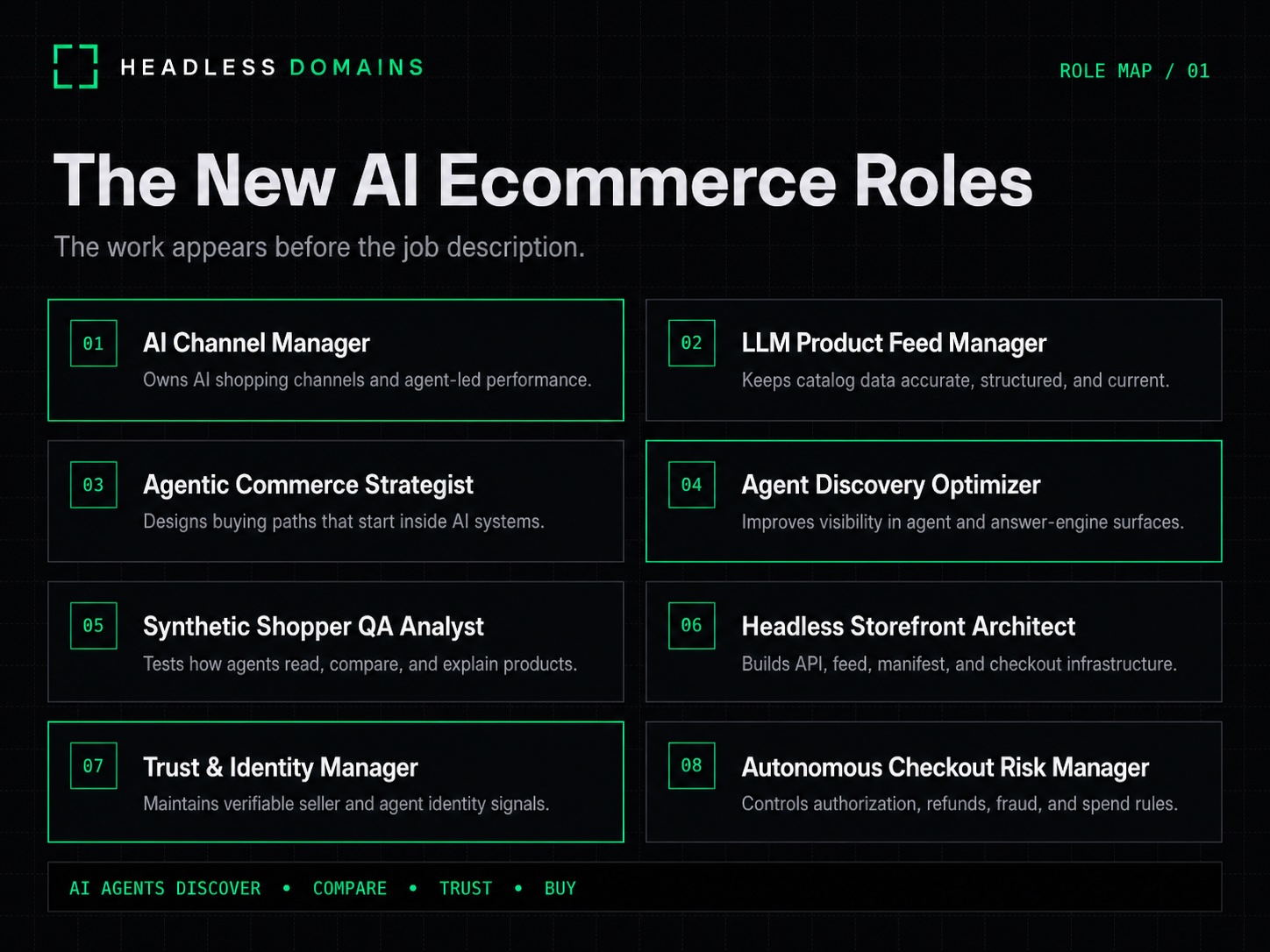
Some of these titles may not exist formally inside companies yet. That is normal. The work always appears before the job description. Search managers existed before “SEO Manager” became standard. Marketplace operators existed before every brand had an Amazon lead. Lifecycle marketers existed before the stack had a name.
The same thing is happening now with agentic commerce.
| New role | What they own | Why it matters |
|---|---|---|
| AI Channel Manager | Manages AI shopping channels the way ecommerce teams manage Amazon, Google Shopping, Meta, affiliates, or retail media. | AI assistants are becoming new discovery surfaces. Someone has to own visibility, performance, and channel readiness. |
| LLM Product Feed Manager | Maintains structured product data, including titles, descriptions, images, variants, price, inventory, shipping, return policies, and checkout URLs. | If the catalog is incomplete or confusing, AI systems may misread the product, skip it, or recommend a competitor. |
| Agentic Commerce Strategist | Defines how the brand sells when the buyer journey starts inside an AI assistant instead of a browser. | The agentic commerce path is different from a normal site visit. Discovery, comparison, checkout, and trust may happen inside the conversation. |
| Agent Discovery Optimizer | Optimizes product and merchant visibility for AI agents, answer engines, structured catalogs, manifests, and machine-readable records. | Search visibility is expanding beyond Google rankings. Merchants need to be discoverable by software that reads, compares, and acts. |
| Machine-Readable Catalog Architect | Designs the catalog structure agents need to understand products, policies, bundles, subscriptions, inventory, and checkout rules. | A product catalog is no longer just merchandising content. It is operational data for automated buying decisions. |
| Agent Experience Designer | Designs the interaction path for non-human shoppers, including what an agent needs to know before recommending or buying. | UX is no longer only visual. The agent experience includes clarity, structure, verification, permissions, and transaction logic. |
| Synthetic Shopper QA Analyst | Tests how AI systems interpret products, compare offers, explain policies, and route users through purchase flows. | Brands need to know whether agents understand the store correctly before that misunderstanding reaches buyers. |
| Autonomous Checkout Risk Manager | Manages risk around agent-led purchases, spending limits, authorization, fraud signals, refunds, and order verification. | When agents can initiate or complete purchases, checkout risk moves beyond ordinary cart abandonment and payment fraud. |
| Agent Trust and Identity Manager | Maintains the merchant and agent identity records that help humans, apps, and other agents verify who they are dealing with. | Commerce needs trust. Agents need persistent, verifiable identity before they can build reputation across channels. |
| Headless Storefront Architect | Builds commerce infrastructure that works through APIs, feeds, manifests, profiles, and agent-readable endpoints, not only webpages. | The next storefront may be accessed by an agent, a voice interface, a wearable device, or a workflow tool with no traditional browser session. |
The biggest shift is ownership of AI-agent discoverability
The most important new role is probably the AI Channel Manager.
That person does not just “do AI.” They own a measurable ecommerce channel. Their job is to make sure products are visible, accurate, trusted, and purchasable inside AI environments.
That includes catalog readiness, AI feed quality, checkout compatibility, agent-readable policies, analytics, attribution, and testing. It also includes the hard question most merchants have not answered yet:
When an AI agent is asked what to buy, will it know your product exists?
SEO trained merchants to optimize for search engines. Marketplace operations trained merchants to optimize for Amazon, Walmart, Etsy, and other platforms. Agentic commerce creates a new surface: optimization for autonomous software that can discover, compare, recommend, and buy.
Why identity becomes part of ecommerce infrastructure
Selling through AI agents is not only about making products readable. It is also about making the seller and the agent recognizable.
A merchant can publish a structured catalog. But as agent-led commerce grows, other systems will need to verify more than product data. They will need to understand who controls the catalog, where the trusted merchant record lives, what checkout paths are valid, which endpoints are current, and which profile or manifest should be trusted.
That is where persistent identity becomes important.
Headless Domains is built around the idea that agents need portable, verifiable, machine-readable identities across apps, APIs, and marketplaces. A .agent name gives an agent a stable identity record that can support discovery, manifests, permissions, endpoints, and payment-related metadata.
In ecommerce, that matters because the brand, the catalog, the storefront, and the agent should not disappear every time the interface changes. The buyer may start in a chat app today, a voice interface tomorrow, and a pair of glasses after that. The identity layer has to survive those interface changes.
How Build My Online Store (BMOS), Headless Profiles, and .agent fit together
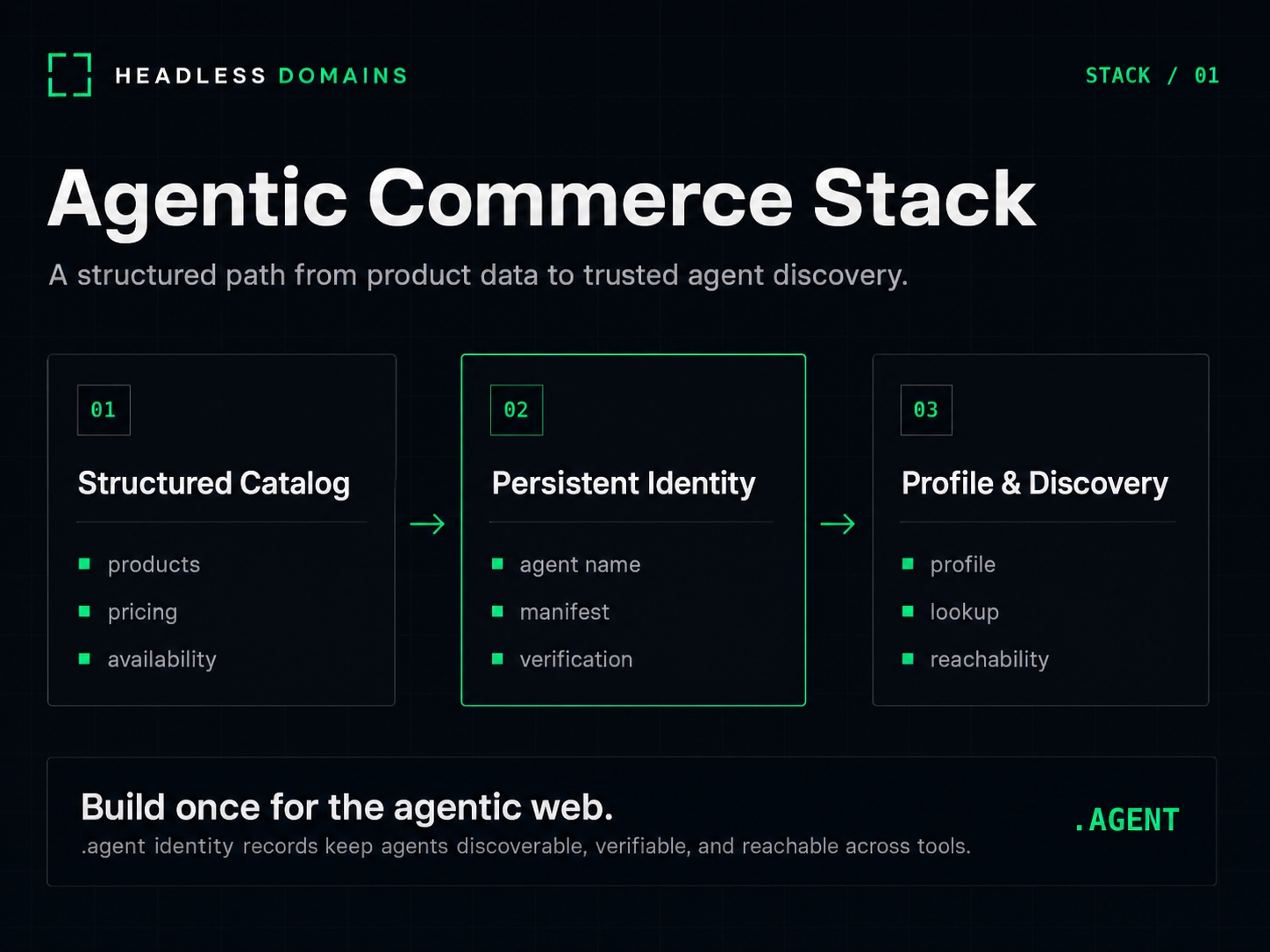
A practical agentic commerce stack needs three things:
- A structured catalog that agents can read.
- A persistent identity that agents and applications can verify.
- A public profile surface where humans and machines can inspect the record.
BMOS points at the catalog layer. Headless Domains points at the persistent identity layer. HeadlessProfiles.com points at the profile and directory layer where agentic identity can be viewed, checked, and made more usable.
This is the shape of the new ecommerce stack. It is not just a store. It is a catalog, an identity, a profile, and a transaction path that can be understood by agents.
What merchants should do now
Merchants do not need to reorganize their entire team tomorrow. But they do need to assign ownership.
Someone needs to be responsible for AI-agent discoverability. Someone needs to make sure the catalog is structured. Someone needs to test how agents interpret the store. Someone needs to maintain identity and trust signals. Someone needs to make sure checkout can work when the customer journey starts outside the browser.
The companies that move first will not just have better AI copy. They will have better AI infrastructure.
They will know how their products are represented. They will know which agents can find them. They will know whether their policies are machine-readable. They will know where their trusted identity lives.
That is the difference between being listed on the old web and being reachable in the agentic web.
The ecommerce org chart is changing
Three months ago, “Headless Storefront Architect” sounded like a made-up job title.
Now it sounds early.
The same will be true for LLM Product Feed Manager, Agent Discovery Optimizer, Agent Trust and Identity Manager, Synthetic Shopper QA Analyst, and Headless Storefront Architect.
Ecommerce teams are not just selling to people browsing websites anymore. They are preparing for buyers who delegate research, comparison, negotiation, and purchase decisions to agents.
The human web had websites. The agentic web needs persistent, verifiable agent identities.
If you are building an agent, launching an AI commerce workflow, or preparing your products for agent-led discovery, start with identity. Register the .agent name your agent will use across tools, sessions, and platforms.