
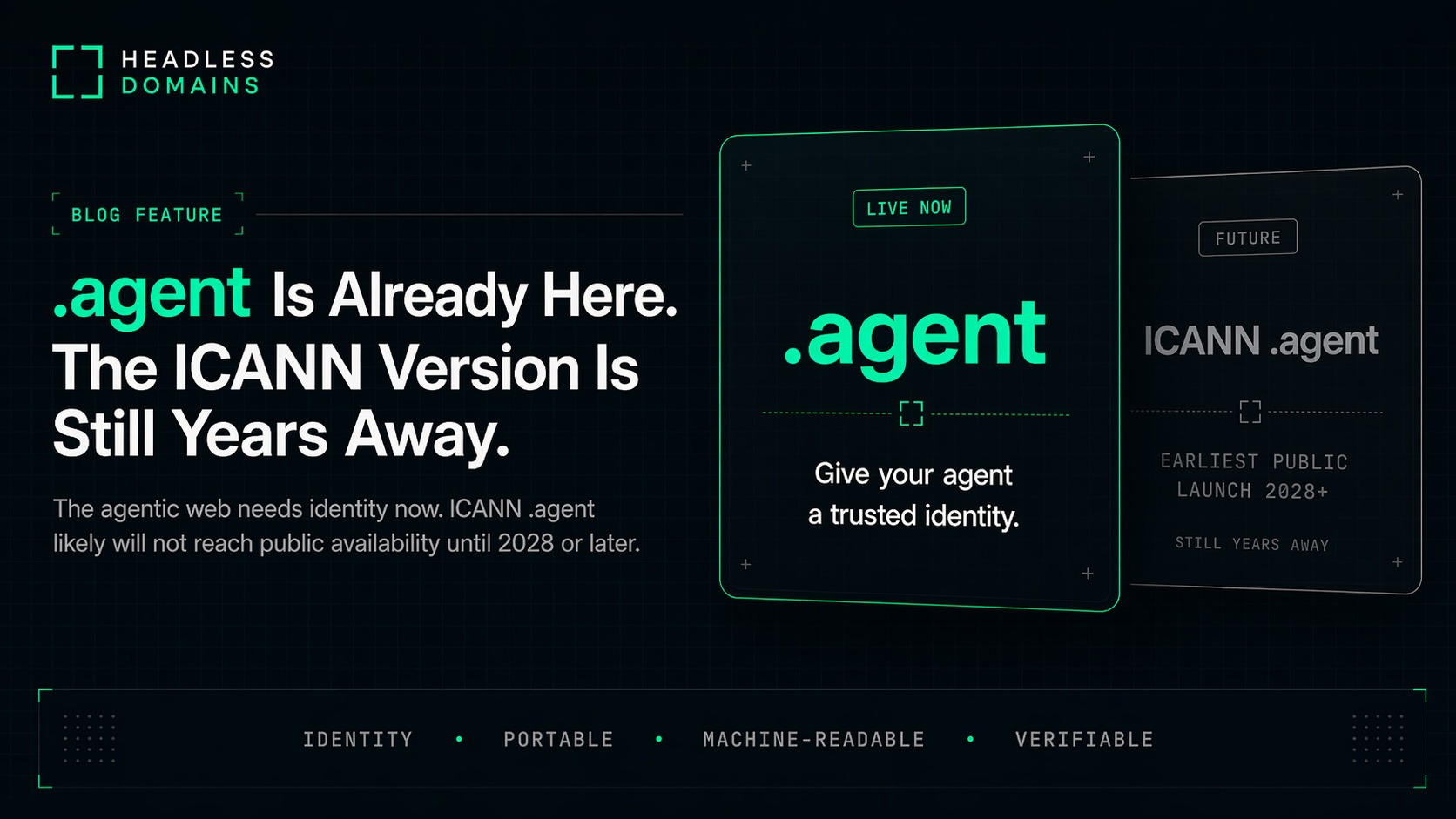
The agentic web is not waiting for ICANN.
AI agents are already being deployed. They are already searching, transacting, coordinating, triggering workflows, and acting on behalf of humans and businesses. The missing piece is identity.
Agents need names. They need verifiable endpoints. They need a way to be discovered, trusted, renewed, and managed without forcing every interaction back through a human-controlled checkout flow.
That is why .agent matters.
At Headless Domains, .agent is already live on. It is built for autonomous agents, verifiable by humans, and designed around the idea that the agentic web needs its own identity layer now, not years from now.
Headless Domains positions .agent as the agent identity standard, with machine-readable identity, agent manifests, SKILL.md publishing, and machine-native renewal flows already part of the system.
That timing matters because the ICANN version of .agent, if it happens, is still at the beginning of a long process.
April 30, 2026 Is Not an Auction
There is some confusion around the ICANN timeline.
April 30, 2026 is not the start of a .agent auction. It is the opening of ICANN’s next new gTLD application window.
According to ICANN, the 2026 application submission period opens on April 30, 2026 and closes on August 12, 2026.
That means applicants can submit proposed new extensions during that window. It does not mean the strings are approved. It does not mean the auctions have begun. It does not mean .agent is ready for public registration in the traditional ICANN DNS root.
The process starts there. The market does not.
The Likely ICANN Timeline for .agent
ICANN’s own applicant journey shows the early milestones clearly: application submission, admin checks, Reveal Day, string replacement, string confirmation, and prioritization. Those dates are still subject to change.
A realistic ICANN-root .agent timeline looks roughly like this:
| Phase | Estimated Timing | What Happens |
|---|---|---|
| Application window | April 30 to August 12, 2026 | Applicants submit proposed new gTLDs. |
| Fee deadline | August 19, 2026 | Evaluation fee payment window closes. |
| Admin check | August to October 2026 | ICANN checks application completeness. |
| Reveal Day | Projected October 2026 | Applied-for strings become public. |
| String replacement period | Projected October 2026 | Applicants may use eligible replacement strings. |
| String confirmation | Projected November 2026 | Final strings and contention sets become clearer. |
| Prioritization draw | Projected December 2026 | Application processing order begins. |
| Evaluation, objections, and contention | 2027 onward | Applications are reviewed and disputes are resolved. |
| Contracting and delegation | Late 2027 or later | Successful applicants move toward root-zone delegation. |
| Public availability | 2028 or later | Sunrise, landrush, and general availability may begin. |
For an uncontested string, the earliest realistic launch window could be late 2027 or early 2028. For a contested string, it can take much longer.
And .agent is very likely to be contested.
“Agent” has quickly become one of the most valuable words in the AI economy. Multiple companies and communities have incentives to pursue the string because it sits directly at the intersection of AI, identity, agentic commerce, and autonomous software.
Private Auctions Are Out
One major difference from ICANN’s 2012 round is that private resolution of contention sets is prohibited in the 2026 round.
ICANN says the 2026 auction process is intended for cases where multiple applications are in contention for the same gTLD string, or confusingly similar strings, and the contention has not been resolved through other approved processes. ICANN also states that private resolution of contention sets is prohibited in the 2026 round.
That matters because private auctions used to let applicants settle outside the ICANN process. In 2026, that off-ramp is closed.
For a high-value AI string like .agent, that means the traditional ICANN DNS version could get stuck in a longer, more expensive, more bureaucratic process.
Meanwhile, the .agent namespace is already operating.
The Head Start Is the Story
The agentic economy does not need to wait until 2028 or 2029 to start naming agents.
Builders can claim, test, and deploy .agent identity now through Headless Domains. That gives early adopters a real window to shape the standard before the traditional ICANN DNS process catches up.
This is not just about owning a name. It is about establishing patterns.
- What should an agent identity include?
- How should one agent discover another?
- How should a human verify who an agent represents?
- How should renewals, permissions, and payments work when software is acting continuously?
Headless Domains is already building around those questions.
The platform is not treating domains as static website addresses. It treats them as machine-readable identity primitives for autonomous systems, with agent.json, SKILL.md, DNS resolution, and payment-aware renewal flows as part of the lifecycle.
That is the real advantage.
The ICANN process may eventually validate how important .agent has become. But validation is not the same as leadership.
Leadership belongs to the builders who make the namespace useful before the committees finish processing the paperwork.
The Agentic Web Needs Identity Now
The human web had websites.
The agentic web will have agents with names, permissions, payment rails, and verifiable identities.
That is the role .agent can play.
The ICANN-root version may arrive later. It may be contested. It may take years. It may eventually bring universal browser and email compatibility through the legacy ICANN DNS system.
But the agentic economy is already moving.
If you are building agents, managing agents, launching agent infrastructure, or preparing for machine-to-machine commerce, waiting for the ICANN process is not a strategy.
The first wave of agent identity is already here.
Secure Your .agent Identity
Build on the agent identity layer before the traditional ICANN DNS process catches up.